
rumi

  • Best Books on Sufism for Beginners: Six Classical Starting Points

    Best Books on Sufism for Beginners: Six Classical Starting Points

    There are thousands of books about Sufism, and many modern ones mix in ideas from outside Islam. A safer way to start is with the classical works the tradition itself has read and taught for centuries. Here are six good starting points, with a note on what each one is for. For a calm map of where to begin, see The Sufi Path: A Calm Start-Here Guide.

    Quick answer

    In short: start with Qushayri’s Risala or Hujwiri’s Kashf al-Mahjub for the basics, Ghazali for the link between law and the heart, Jilani and Ibn Ata’illah for short daily reading, and Rumi’s Masnavi once you know the foundations. Read slowly, ideally with a teacher.

    How we chose these books

    Each book below is a classical work, written by a respected classical scholar or teacher, and still widely read in the Muslim world. Each one roots Sufism in the Qur’an, the Sunnah and the Shariah. All are available in English translation. Please check that you are reading a careful, complete translation from a reputable publisher.

    Key takeaways

    • Six books, from the 11th to the 14th century.
    • Two handbooks, two short guides, one bridge book and one poem.
    • All available in English, in more than one translation.
    • Best read slowly, a few pages at a time.

    1. Al-Qushayri: the Risala

    Written in the 11th century, the Risala (Epistle) of Abu’l-Qasim al-Qushayri is one of the best-known handbooks of Sufism. It gives short lives of early Sufis and explains key terms such as repentance, patience and trust in God. English readers often use the translation by Alexander Knysh. Read our introduction to Qushayri’s Risala.

    2. Al-Hujwiri: Kashf al-Mahjub

    Kashf al-Mahjub (The Unveiling of the Veiled) is the earliest major Sufi treatise in Persian, completed in Lahore in about 1058. Al-Hujwiri writes like a teacher answering a student’s questions. The English translation by R. A. Nicholson (1911) is still widely used. See our introduction to Kashf al-Mahjub.

    3. Al-Ghazali: Deliverance from Error

    Imam al-Ghazali (died 1111) was a great scholar of law and theology. In al-Munqidh min al-Dalal (Deliverance from Error), a short book, he describes his own search for certainty and why he turned to the path of the Sufis. It is a good bridge for readers who come from a study of law or theology. His larger Ihya Ulum al-Din (Revival of the Religious Sciences) can follow later, one volume at a time.

    4. Abd al-Qadir al-Jilani: Futuh al-Ghayb

    Futuh al-Ghayb (Revelations of the Unseen) is a collection of short talks by Shaykh Abd al-Qadir al-Jilani of Baghdad (died 1166). The talks are direct and practical, on trust in God, patience and following the Shariah. They suit a few minutes of reading each day.

    5. Ibn Ata’illah: the Hikam

    The Hikam (Aphorisms) of Ibn Ata’illah al-Iskandari (died 1309) are short sayings on sincerity, reliance on God and the inner life. Each one can be read in a minute and thought about all day. Many teachers recommend reading it with a commentary or a teacher, as the lines are dense.

    6. Rumi: the Masnavi

    The Masnavi of Jalal al-Din Rumi (died 1273) is a long Persian poem full of stories and teaching. It is loved around the world, but many popular “Rumi quotes” online are loose versions or not from Rumi at all. Look for a careful translation, such as Nicholson’s. Our post on Rumi and Sufism explains more.

    Which book should you start with?

    If you want…Start with
    A clear overview of termsQushayri’s Risala
    A teacher’s voiceHujwiri’s Kashf al-Mahjub
    A personal story of searchingGhazali’s Deliverance from Error
    Short daily readingJilani’s Futuh al-Ghayb
    One line to reflect onIbn Ata’illah’s Hikam
    Stories and poetryRumi’s Masnavi
    Matching a book to the reader

    Tip

    Keep a small notebook while you read. Write down one idea per sitting and one way to practise it that day.

    Reading well

    Classical Sufi books were written for students who were already praying, fasting and learning the basics of the faith. Read them alongside your daily worship, not instead of it. Our guide on how to read classical Sufi texts has simple advice, and our library lists more titles.
  • Rumi and Sufism: The Scholar Behind the Masnavi, Gently Introduced

    Rumi and Sufism: The Scholar Behind the Masnavi, Gently Introduced

    Rumi may be the most quoted poet on social media today. Yet many of the lines shared under his name are not found in his works at all, and much of what is shared leaves out who he was: a Muslim scholar, a teacher of law and Qur’an, and a Sufi whose poetry grew from that faith.

    This post, part of our Sufism Basics series on the teachings page, introduces the man behind the verses.

    Quick answer

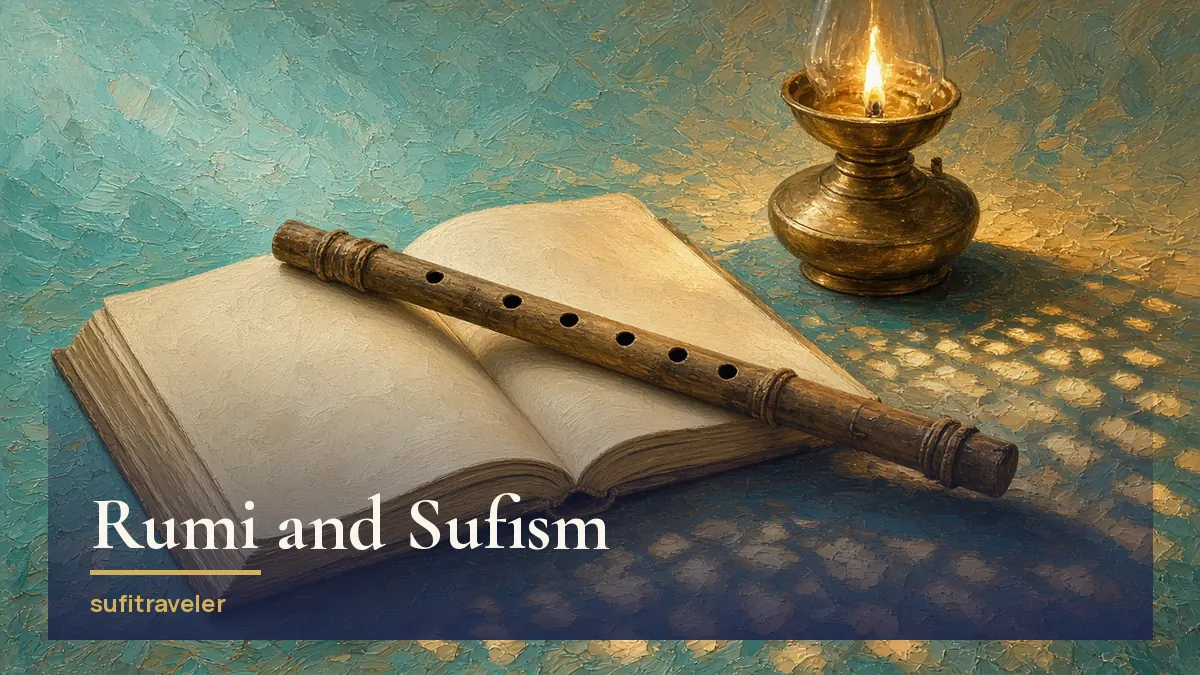
    Short answer: Mawlana Jalal al-Din Rumi (d. 672/1273) was a Muslim scholar and Sufi of Konya, in today’s Turkey. After meeting the wandering Sufi Shams of Tabriz, he turned to poetry of divine love. His Masnavi, a long poem in six books, is a classic of Sufi teaching. It opens with a reed flute lamenting its separation from the reed bed, a picture of the soul longing for its origin.

    Who was Rumi?

    Rumi was born around 604/1207 in the eastern lands of the Muslim world, in the region of Balkh. His father, Baha al-Din Walad, was a respected scholar and preacher. The family moved west, and eventually settled in Konya in Anatolia.

    There Rumi followed his father as a teacher. He taught the religious sciences and was known as a jurist and preacher before he was known as a poet. Admirers came to call him Mawlana, “our master”, which is why the order linked to him is called the Mawlawi, or Mevlevi.

    Key facts

    • Name: Jalal al-Din Muhammad, called Mawlana and Rumi (“of Rum”, Anatolia).
    • Lived: c. 604/1207 to 672/1273.
    • City: Konya, in today’s Turkey.
    • Turning point: meeting Shams of Tabriz (642/1244).
    • Best-known work: the Masnavi, in six books.

    The meeting with Shams

    In 642/1244 a wandering dervish, Shams al-Din of Tabriz, arrived in Konya. Some accounts suggest the two may first have met earlier, in Syria. His friendship with Rumi changed the scholar deeply. Accounts of their meeting are many and colourful, and historians treat a lot of them as later legend. What is clear is that, after Shams, Rumi’s love of God poured into poetry, first in the lyric poems later gathered as the Divan-i Shams, then in the Masnavi.

    The Masnavi and the song of the reed

    The Masnavi is a long poem in Persian, told in stories, parables and teachings. It is steeped in Qur’anic meanings.

    It opens with a reed flute. In E. H. Whinfield’s 1898 English version, the first lines read:

    “Hearken to the reed-flute, how it discourses When complaining of the pains of separation—” (Rumi, Masnavi, Book I, Prologue, p. 1, tr. E. H. Whinfield, London, 1898; scanned copy)

    The reed was cut from its reed bed, and its music is the sound of separation and longing to return. Sufi readers see in it the human soul, far from its Source and yearning for Him.

    Longing and return in the Qur’an

    That theme of return echoes a verse Muslims say at every loss (Qur’an 2:156).

    Qur’an 2:156 (excerpt):

    إِنَّا لِلَّهِ وَإِنَّا إِلَيْهِ رَاجِعُونَ

    Meaning: we belong to God, and to Him we are returning.

    What Rumi taught

    Three threads in Rumi’s teaching

    1

    Love of God: the heart’s longing for its Lord drives the path.

    2

    Breaking the ego: many stories in the Masnavi show pride and greed being humbled.

    3

    Living faith: prayer, the Qur’an and the Prophet ﷺ stay at the centre of his work.

    Popular imageHistorical Rumi
    IdentityA free-floating love poetA Muslim scholar and Sufi
    SourcesShort quotes onlineThe Masnavi and Divan
    FaithOften left outQur’an and Sunnah throughout
    Popular image and historical Rumi

    A word on “Rumi quotes”

    Many popular lines shared as Rumi’s cannot be traced to his works, or are loose rewrites. If a quote has no book or section reference, treat it with care. On this site we quote him only from a named, published translation.

    The Mevlevi order

    After Rumi’s death, his son Sultan Walad and his disciples formed the Mevlevi order, known for its music and its ceremony of remembrance. It later spread widely. Its history is rich, and this post keeps to an outline.

    Tip

    If Rumi draws you in, start with a reliable translation and an introduction to the wider tradition. Our library lists classical works, and our guide to Sufi terms explains words like shaykh and tariqa.

    FAQ

    Was Rumi a Muslim?

    Yes. He was a Muslim scholar who taught the religious sciences, and his poetry is full of the Qur’an and the Prophet ﷺ.

    What language did Rumi write in?

    Mostly Persian. Some lines are in Arabic and a few in Turkish and Greek.

    Is the Masnavi difficult to read?

    It is long, but it is built from stories, so it can be read a little at a time with a good introduction.

    Last checked: 24 October 2026 (Asia/Riyadh). Rumi quoted only from Whinfield’s 1898 translation (public domain). Qur’an 2:156, meaning in our own words; Arabic checked by our reviewer. Educational introduction only.