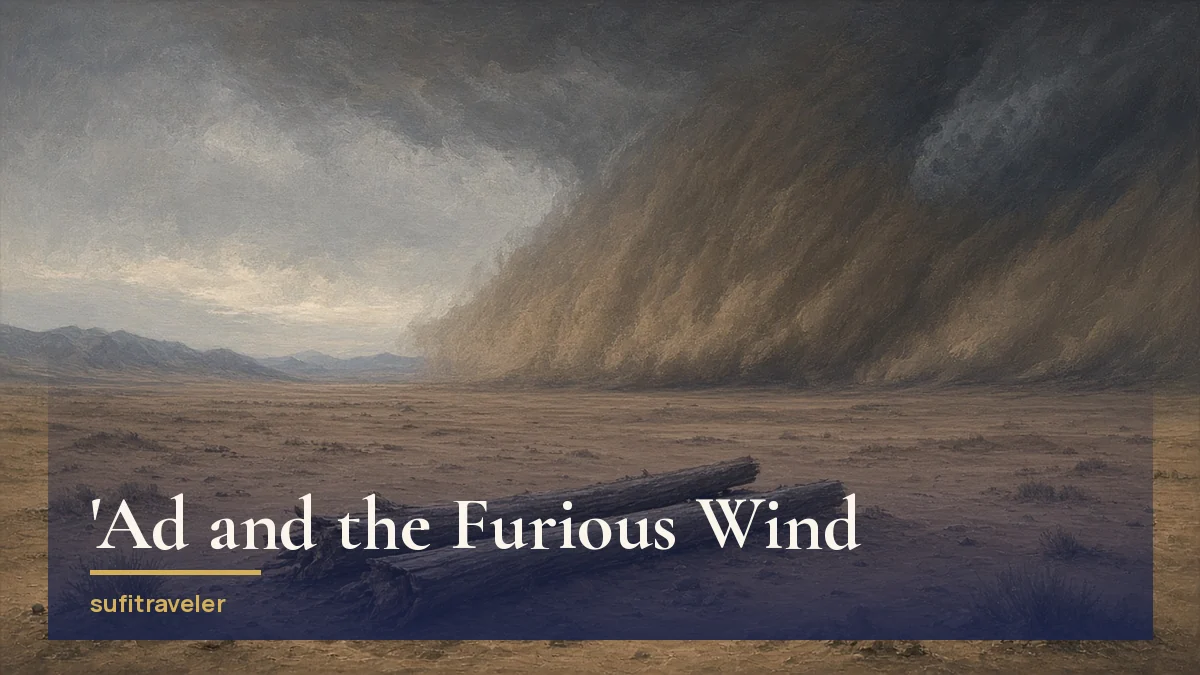
In our last story, the Prophet Hud, peace be upon him, called the people of ‘Ad to God, and they challenged him to bring the punishment he warned of. This story picks up where that one stopped: the wind.
This is day eight of our Qur’an Stories series. The Arabic below is the Uthmani text. The English meanings are our own wording, and the commentary comes from Ibn Kathir. It is a reflection on meaning, not a ruling.
Quick answer
Short answer: ‘Ad saw a cloud coming towards their valleys and rejoiced, thinking it was rain (46:24). It was a cold, roaring wind that God set upon them for seven nights and eight days without a break (69:6-7), until only their dwellings were left standing (46:25).
Where the wind is described
“Who is stronger than us?”
Before the wind came, the Qur’an names the root of the problem:
فَأَمَّا عَادٌۭ فَٱسْتَكْبَرُوا۟ فِى ٱلْأَرْضِ بِغَيْرِ ٱلْحَقِّ وَقَالُوا۟ مَنْ أَشَدُّ مِنَّا قُوَّةً
In meaning: as for ‘Ad, they were arrogant in the land without right, and said, “Who is stronger than us?” (41:15).
A people who trusted in their own strength were undone by something they could not see: moving air.
The cloud they welcomed
فَلَمَّا رَأَوْهُ عَارِضًۭا مُّسْتَقْبِلَ أَوْدِيَتِهِمْ قَالُوا۟ هَٰذَا عَارِضٌۭ مُّمْطِرُنَا
In meaning: when they saw it as a cloud spreading across the sky, heading for their valleys, they said, “This cloud will bring us rain” (46:24).
Ibn Kathir, on 46:24, explains why they were glad: they had been suffering a drought and needed rain, so the sight of clouds made them happy. What looked like relief was the very punishment they had dared Hud to bring.
Warning
Ibn Kathir, on 46:21, also passes on reports about where ‘Ad lived, such as Qatadah’s report that they were a tribe in Yemen among the sand hills. We treat these as reports, not as part of the Qur’anic text.
Seven nights and eight days
سَخَّرَهَا عَلَيْهِمْ سَبْعَ لَيَالٍۢ وَثَمَٰنِيَةَ أَيَّامٍ حُسُومًۭا
In meaning: He set it upon them for seven nights and eight days, without a break (69:7).
Ibn Kathir, on 69:6-7, gathers the early explanations of three words:
| Word | Meaning reported by Ibn Kathir |
|---|---|
| ṣarṣar (صَرْصَر) | Cold (Ad-Dahhak); Ibn Kathir himself glosses it as “a cold wind” |
| ʿātiyah (عَاتِيَة) | Blowing severely (Qatadah, As-Suddi and others), without mercy or blessing (Ad-Dahhak) |
| ḥusūm (حُسُوم) | In succession, without a break (Ibn Mas’ud, Ibn ‘Abbas, Mujahid and others) |
Under the same verse he cites the Prophet’s words, peace and blessings be upon him, as reported by Ibn ‘Abbas (Sahih al-Bukhari 1035; Sahih Muslim 900): “I was helped by the east wind, and ‘Ad were destroyed by the west wind.” The same air brought victory to one and ruin to others, by God’s command.
A barren wind
وَفِى عَادٍ إِذْ أَرْسَلْنَا عَلَيْهِمُ ٱلرِّيحَ ٱلْعَقِيمَ
In meaning: in ‘Ad, too, there is a sign, when We sent against them the barren wind (51:41).
Wind normally carries clouds and pollen and brings life. Ibn Kathir, on 51:41, reports from Ad-Dahhak and Qatadah that this wind was barren: it destroyed and produced nothing.
Is any of them left?
فَهَلْ تَرَىٰ لَهُم مِّنۢ بَاقِيَةٍۢ
In meaning: do you see any trace of them remaining? (69:8). Surah al-Ahqaf ends the scene the same way: they became such that nothing could be seen except their homes (46:25). Surah al-Qamar calls it a day of continuous calamity (54:19), and then asks, in meaning, how was My punishment and My warning? (54:18).
Reading these verses for yourself
1
Read 46:24-25 slowly and notice the moment hope turns to fear.
2
Read 69:6-8 and picture the seven nights and eight days.
3
Read 41:15 and ask where you rely on your own strength.
4
Finish with 54:17, which reminds you the Qur’an is made easy to remember.
Lessons for the heart
Reflections
- What looks like rain may be a test, and what looks like hardship may be mercy.
- Strength without humility is the boast of ‘Ad: “Who is stronger than us?”
- Wind is a servant of its Lord. It moves “by the command of its Lord” (46:25).
- Asking to hurry punishment is never wise. Ask instead for forgiveness, as Hud invited them to.
Tip
Read this story with the Hud story open alongside it. The call comes first, then the wind. Together they show how patient the warning was before the end came.