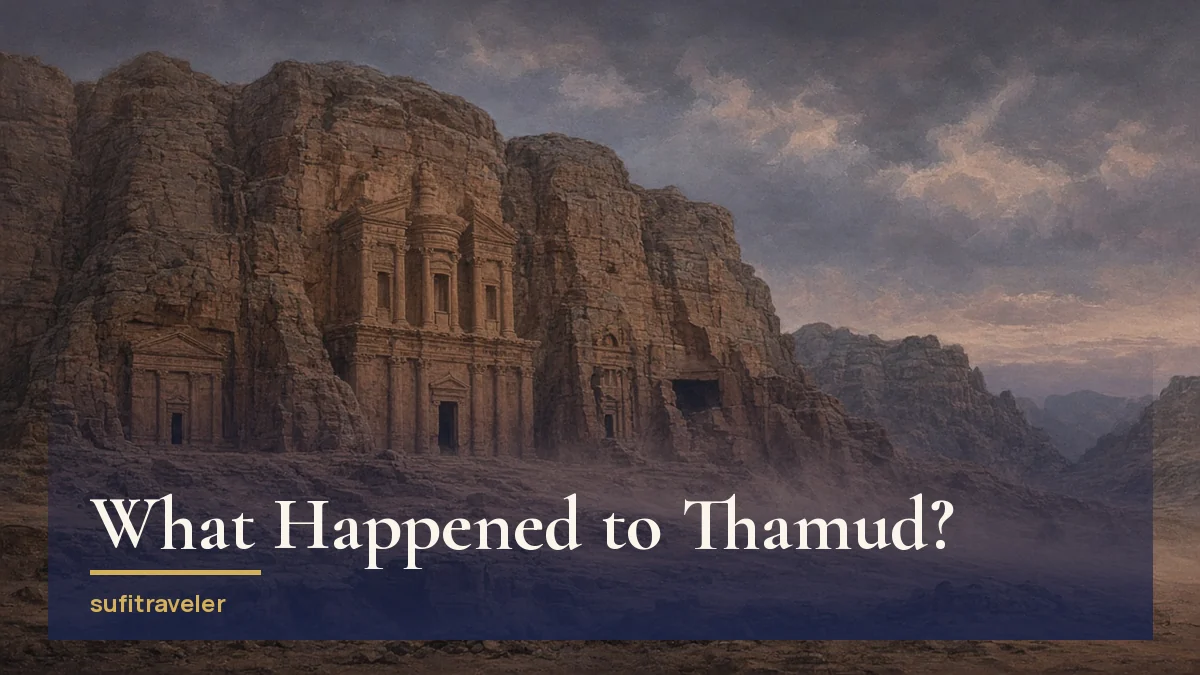
Thamud had asked for a sign, and God sent one: a she-camel, with a simple command to leave her unharmed. This morning’s post told the story of Prophet Salih and the she-camel. This one asks what happened next, and why the Prophet ﷺ wanted believers to remember it.
This is day ten of our Qur’an Stories series. The English meanings below are our own wording. It is a reflection on meaning, not a ruling.
Quick answer
Short answer: The most wretched of Thamud rose up and hamstrung the camel (91:12-14). Salih gave them three days (11:65). Then a single blast seized them, and they lay lifeless in their homes (54:31, 11:67). God saved Salih and the believers (11:66, 27:53).
Where the story appears
Where Thamud’s end is told
- Surah ash-Shams: the most wretched one and the deed (91:11-15).
- Surah al-Qamar: their scorn for one man among them, the shared water and the blast (54:23-31).
- Surah an-Naml: the nine men who plotted against Salih (27:45-53).
- Surah al-Hijr: the people of the rocky tract and their carved homes (15:80-84).
Why did they turn on the camel?
Surah al-Qamar shows the root of it. Thamud said, in meaning: are we to follow one man from among us? Then we would be lost. Was the message given to him alone? No, he is an arrogant liar (54:24-25).
God answered that tomorrow they would know who the arrogant liar was. He was sending the she-camel as a trial for them, so Salih should watch them and be patient (54:26-27). The water was to be divided between them, each drinking in turn (54:28).
Who did it?
The Qur’an does not give his name. It calls him “the most wretched of them”, who rose up for the deed (91:12). Thamud called their companion, and he took hold and hamstrung her (54:29).
The Qur’an puts the deed on all of them (91:14): they rejected Salih and they hamstrung her. They agreed to it, and they boasted afterwards, challenging Salih to bring what he had warned them of (7:77).
The Prophet ﷺ once mentioned this in a sermon. He described the man who hamstrung the camel as a strong, powerful man among his people (Sahih al-Bukhari 4942, narrated by ‘Abdullah ibn Zam’a).
What was the plot of the nine?
Surah an-Naml adds a darker detail. In the city were nine men who spread corruption in the land and never set things right. They swore by God to attack Salih and his family by night, and then tell his heir they had not witnessed it (27:48-49).
They planned, and God also planned, while they did not perceive it (27:50). Their plan came to nothing.
What happened in the three days?
After the deed, Salih told them: enjoy yourselves in your homes for three days. That is a promise that will not be broken (11:65). There was still a short space of time, a final notice.
How the end unfolded in the Qur’an
1
The deed: they hamstrung the camel and defied the command (7:77).
2
The notice: three days in their homes (11:65).
3
The rescue: Salih and the believers were saved by God’s mercy (11:66).
How did their end come?
The Qur’an describes it in more than one way: a tremor seized them (7:78), and a single mighty blast struck them (54:31). Afterwards it was as if they had never lived there (11:68). The homes they carved so carefully could not protect them (15:82-84).
Surah ash-Shams closes with a quiet line: God does not fear the outcome (91:15). Salih turned away from them, saying, in meaning: I conveyed my Lord’s message to you and advised you, but you do not love those who advise (7:79).
What did the Prophet ﷺ teach about it?
Passing al-Hijr with his Companions, the Prophet ﷺ told them not to enter the dwellings of those who were punished unless weeping, so that what struck them would not strike them too, and he hurried through (Sahih Muslim 2980b, narrated by ‘Abdullah ibn ‘Umar; the instruction is also in Sahih al-Bukhari 433).
Note
Our reflection: the lesson is not curiosity about ruins. It is a soft heart, and a fear of becoming like those who ignored a clear sign.
Lessons for the heart
- Silent approval counts. One man acted, but a people who called on him and shared the deed shared the blame (91:14).
- Love those who advise you. Salih’s last words were about sincere counsel rejected (7:79).
- God’s plan outlasts every plot (27:50).
- Pass by with a humble heart. That was the Prophet’s ﷺ teaching.
The series continues; browse all Qur’an Stories, or go back to Prophet Hud.
Sources
Verse meanings are our own wording, cross-checked for sense against standard translations: 91:11-15, 54:23-31, 27:45-53, 11:65-68, 7:77-79 and 15:80-84.
Hadith: Sahih al-Bukhari 4942 and Sahih al-Bukhari 433 and Sahih Muslim 2980b.