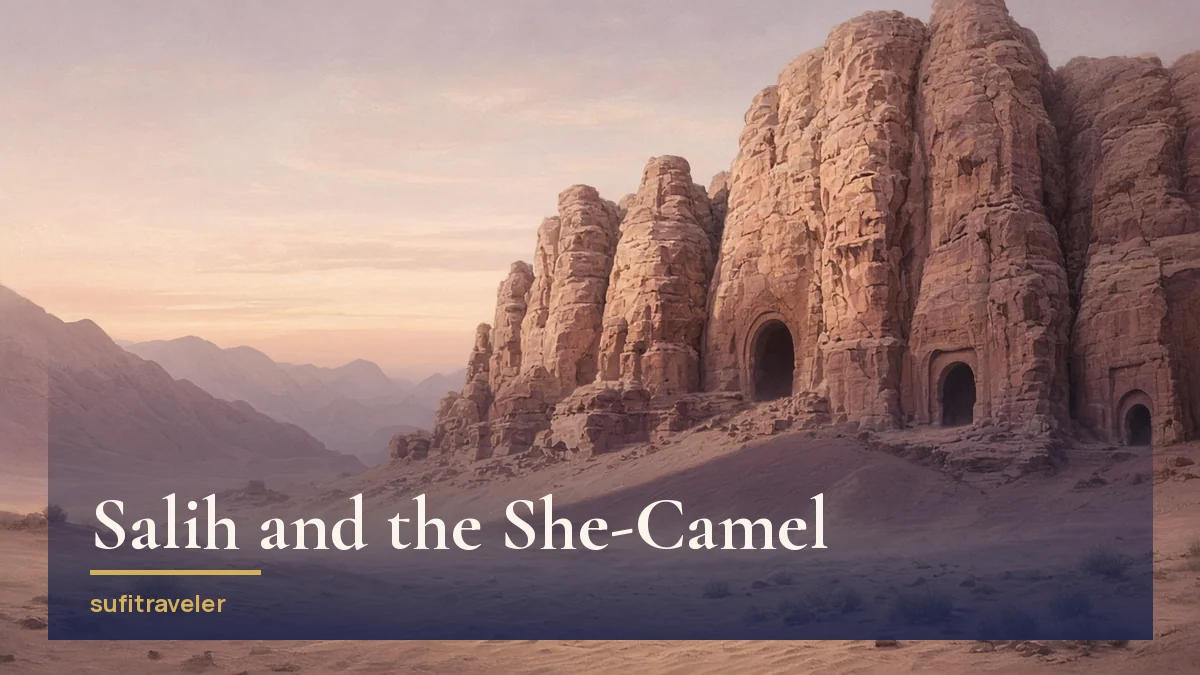
After ‘Ad came another strong nation: Thamud. They carved homes into mountains and lived among gardens and springs. God sent them their brother Salih, peace be upon him, and gave them a sign they could see with their own eyes: a she-camel.
This is day nine of our Qur’an Stories series. Earlier we followed Prophet Hud and the people of ‘Ad. Here we ask a simple question: why was the she-camel a test? The English meanings below are our own wording. It is a reflection on meaning, not a ruling.
Quick answer
Short answer: Salih called Thamud to worship God alone (11:61). They asked for a sign, and God sent a she-camel with a share of water on fixed days (26:154-155). They were told not to harm her (7:73). The camel was a clear sign, and signs are sent as a warning (17:59).
Where the story appears
Where Salih appears in the Qur’an
- Surah al-A’raf: Salih’s call and the sign of the she-camel (7:73-79).
- Surah Hud: his hopes for his people and their doubt (11:61-68).
- Surah ash-Shu’ara: their comforts, their demand for a sign and the shared water (26:141-159).
- Surah al-Isra: the she-camel named as a visible sign (17:59).
Who were Thamud?
The Qur’an tells us that God made Thamud successors after ‘Ad and settled them in the land. They built palaces on its plains and carved houses out of the mountains (7:74). They had gardens, springs, crops and palms with soft, tender clusters (26:146-148).
Salih reminded them that it was God who brought them out of the earth and settled them in it (11:61). Their skill was real, but it was a gift, not their own making alone.
What did Salih ask of them?
His message was the same as Hud’s before him: worship God, you have no god but Him. Ask His forgiveness and turn back to Him, for He is near and answers (11:61).
Like every prophet, he asked no payment. In meaning (our words): I ask you for no reward for this; my reward is only with the Lord of the worlds (26:145). He also warned them not to obey the extravagant, who spread corruption and never set things right (26:151-152).
Why did his people doubt him?
Their answer is striking. They said, in meaning (our words): Salih, you were someone we looked to before this (11:62). They had placed their hopes in him. Now he was asking them to leave what their fathers worshipped, and they said they were in deep doubt about his call.
They also called him bewitched and said he was only a man like them (26:153-154). Then they asked for proof: bring us a sign, if you are truthful.
Why a she-camel?
God answered their request. Salih said, in meaning (our words): this is the she-camel of God, a sign for you. Leave her to graze on God’s earth and do not touch her with harm, or a painful punishment will seize you (7:73, 11:64).
She came with a rule. She would have her share of water, and they would have theirs, each on a known day (26:155). The Qur’an calls her a clear sign, and says signs are sent only to warn (17:59).
| They asked for | The test asked them to |
|---|---|
| A visible sign (26:154) | Believe what they had seen |
| Proof of Salih’s truth | Leave her free to graze (7:73) |
| Something to settle their doubt (11:62) | Share their water on fixed days (26:155) |
What made it a test?
Our reflection: the sign did not ask them to do anything hard. It asked them to hold back. Leave her alone. Share the water. Sometimes the real test is not doing more, but making room for what God has placed among us.
The Qur’an also shows a split among the people. The proud chiefs asked the weaker believers whether they truly thought Salih was sent by his Lord. The believers said yes, they believed in his message. The proud said they rejected it (7:75-76).
Tip
A small habit from this story: when you ask God for a sign or an answer, be ready to act on it when it comes.
How did it end?
In one line: they hamstrung the camel and defied God’s command (7:77), and God saved Salih and the believers by His mercy (11:66). We tell what happened to Thamud in full in our next story.
Lessons for the heart
- Gifts point to the Giver. Homes, gardens and skill all came from God.
- Signs bring responsibility. Asking for proof means being ready to follow it.
- Restraint can be worship. The command was simply: do not harm her.
- God is near. Salih told them, in meaning (our words): my Lord is near and answers (11:61).
Sources
Verse meanings are our own wording, cross-checked for sense against standard translations: 7:73-79, 11:61-68, 26:141-159 and 17:59.