Malik Sherjeel Awan

  • The Neighbour, the Guest, and Speaking Good: A Hadith on Daily Manners

    The Neighbour, the Guest, and Speaking Good: A Hadith on Daily Manners

    By Dr. Malik Sherjeel Awan, PsyD

    Three everyday matters sit together in one short teaching of the Prophet ﷺ: the neighbour, the guest, and the words that leave your mouth. The wording is almost the same in Sahih al-Bukhari and Sahih Muslim, narrated from Abu Huraira. In Sahih al-Bukhari 6018 the Prophet ﷺ said:

    “Anybody who believes in Allah and the Last Day should not harm his neighbor, and anybody who believes in Allah and the Last Day should entertain his guest generously and anybody who believes in Allah and the Last Day should talk what is good or keep quiet.”

    A close wording is also in Sahih al-Bukhari 6136, and in Sahih Muslim 47: “He who believes in Allah and the Last Day should either utter good words or better keep silence; and he who believes in Allah and the Last Day should treat his neighbour with kindness and he who believes in Allah and the Last Day should show hospitality to his guest.” Quotations are from the English translations on sunnah.com.

    The teaching is not presented as optional courtesy. Each line begins with faith in Allah and the Last Day. How we treat the person next door, the person under our roof, and the people who hear us speak is treated as part of that faith.

    The neighbour

    The Qur’an already places the neighbour among those to whom good is owed: “Worship Allāh and associate nothing with Him, and to parents do good, and to relatives, orphans, the needy, the near neighbor, the neighbor farther away, the companion at your side, the traveler, and those whom your right hands possess. Indeed, Allāh does not like those who are self-deluding and boastful” (Qur’an 4:36, Sahih International).

    The hadith is practical. In Bukhari’s wording the duty is first stated as “should not harm” the neighbour; in Muslim’s wording it is “treat his neighbour with kindness.” Together they cover two sides of the same manners: do not cause injury or distress, and be actively kind. That can be as ordinary as keeping noise down, returning what you borrow, checking on someone who is unwell, or simply not making their day harder.

    The verse mentions both “the near neighbor” and “the neighbor farther away.” The hadith itself does not define the radius, and scholars have discussed that in different ways. For daily life, the people whose door is next to yours are the first test of the teaching.

    The guest

    Hospitality here is “entertaining” or “showing hospitality” to a guest generously. The hadith does not set a menu, a time limit, or a formal ritual. It asks for a generous welcome: food and drink if you can offer them, a place to sit, and a manner that does not make the guest feel like a burden.

    Generosity is also not the same as showing off. The same Qur’an verse ends by saying that Allah does not like those who are “self-deluding and boastful.” A simple, sincere welcome is enough. If your means are limited, kindness still counts; the hadith does not demand a feast that you cannot give.

    Speaking good, or remaining silent

    The third line may be the one we practise least. “Talk what is good or keep quiet.” Muslim’s wording is just as clear: “utter good words or better keep silence.”

    This is not a ban on ordinary conversation, humour, or necessary speech at work and at home. It is a standard for what is worth saying. If a sentence will not help, will harm a neighbour’s reputation, or is only meant to impress, the hadith offers a simple alternative: do not say it.

    As a psychologist, I notice how often regret comes after a sentence, not before it. A short pause — is this true, is it useful, is it kind? — is often enough. Silence is not coldness. In this teaching it is a form of care.

    Keeping the three together

    It is easy to treat these as three separate tips. The Prophet ﷺ tied them to the same sentence about faith, which suggests they belong to one character. A person who is generous to a guest and harsh to the family next door has only kept part of the teaching. A person who is polite in public and careless with their tongue in a private chat has only kept part of it too.

    None of this replaces a formal ruling in a specific case — for example, when speech is required to stop harm, or when a guest’s stay needs a clear limit. For those details, ask a qualified scholar. The hadith itself is a starting point for daily manners, and it is enough to begin with today: do not harm the neighbour, welcome the guest, and speak good or remain silent.

    For a wider picture of character in this tradition, see Good Character (Husn al-Khuluq) and The Sufi Path: A Calm Start-Here Guide.

    For study and reflection. For rulings, consult a qualified scholar.

    Sources

    • Hadith: Sahih al-Bukhari 6018 (Abu Huraira): sunnah.com
    • Hadith: Sahih al-Bukhari 6136 (Abu Huraira): sunnah.com
    • Hadith: Sahih Muslim 47 (Abu Huraira): sunnah.com
    • Qur’an 4:36 (Sahih International, checked via api.quran.com on 16 Nov 2026)
  • Salawat on the Prophet ﷺ: Authentic Wordings with Transliteration and Meaning

    Salawat on the Prophet ﷺ: Authentic Wordings with Transliteration and Meaning

    Salawat means asking God to send His blessings on the Prophet Muhammad ﷺ. The Qur’an commands it, and the Prophet ﷺ taught the exact words. It is one of the core forms of remembrance in our guide to dhikr in Islam.

    Transliterations are standard romanisations; the English meanings are our own wording. This remembrance also sits in our duas section.

    Quick answer

    Short answer: God and His angels send blessings on the Prophet, and believers are told to do the same (33:56). The fullest wording is the Ibrahimi salawat (Bukhari 3370). Whoever sends one salawat receives ten blessings from God (Muslim 408), and the Prophet ﷺ asked for more of it on Friday (Abu Dawud 1047).

    The command in the Qur’an

    In meaning (our own paraphrase): God and His angels send blessings on the Prophet. O you who believe, send blessings on him and greet him with a full greeting of peace (33:56).

    The Ibrahimi salawat

    Ka’b ibn ‘Ujra reported that the Companions asked the Prophet ﷺ how to send blessings on him, since they had already been taught how to greet him. He told them to say (Bukhari 3370):

    Allahumma salli ‘ala Muhammadin wa ‘ala ali Muhammad, kama sallayta ‘ala Ibrahima wa ‘ala ali Ibrahim, innaka Hamidun Majid. Allahumma barik ‘ala Muhammadin wa ‘ala ali Muhammad, kama barakta ‘ala Ibrahima wa ‘ala ali Ibrahim, innaka Hamidun Majid.

    In meaning: O God, send Your blessings on Muhammad and the family of Muhammad, as You sent blessings on Ibrahim and the family of Ibrahim; You are Praiseworthy, Glorious. O God, bless Muhammad and the family of Muhammad, as You blessed Ibrahim and the family of Ibrahim; You are Praiseworthy, Glorious.

    Notice how the Companions asked: they wanted the exact words, not their own. The Prophet ﷺ answered with a precise wording. It is commonly recited in the tashahhud of the prayer, and can also be said at any time.

    Note

    Another authentic wording, from Abu Humayd al-Sa’idi, mentions the Prophet’s wives and descendants in place of “the family of Muhammad” (Bukhari 3369). Both are taught in Sahih al-Bukhari.

    The short form

    In everyday speech, when the Prophet’s name is mentioned, Muslims say sallallahu ‘alayhi wa sallam: may God bless him and grant him peace. The verse itself uses both words: sallu (send blessings) and sallimu (greet with peace) (33:56).

    One for ten

    Abu Huraira reported that the Prophet ﷺ said, in meaning: whoever sends one blessing on me, God sends ten blessings on him (Muslim 408).

    At a glance

    More on Friday

    Aws ibn Aws reported that the Prophet ﷺ said, in meaning: among the best of your days is Friday, so send many blessings on me on that day, for your blessings are presented to me (Abu Dawud 1047; Sahih (al-Albani)). A later guide in this series will cover the rest of Friday’s remembrances.

    Short formIbrahimi salawat
    WordingSallallahu ‘alayhi wa sallamAllahumma salli ‘ala Muhammad…
    Best forWhen his name is mentionedPrayer, and set times of dhikr
    SourceCommon practice when his name is mentionedBukhari 3370
    Two wordings

    Making it a habit

    A simple routine

    1

    Say it in the tashahhud of each prayer, as is common practice.

    2

    Say sallallahu ‘alayhi wa sallam whenever you say or hear his name.

    3

    Add a set of salawat to your morning or evening adhkar.

    4

    On Friday, increase it throughout the day.

    Keep going

    Read La ilaha illallah and the live morning and evening adhkar next; a later guide will cover dhikr on Friday. For the whole picture, return to our complete guide to dhikr.

    This is general education, not a religious ruling. Ask a qualified scholar about specific practices.

  • The Prophet’s Coming Is Itself a Sign: Signs of the Hour, Part 2

    The Prophet’s Coming Is Itself a Sign: Signs of the Hour, Part 2

    In the first post of this series we saw that only Allah knows when the Hour comes. That rule stays with us all the way through. Now we begin the signs themselves, and the first sign in our series may surprise some readers: the coming of the Prophet ﷺ is itself counted as a sign that the Hour is near.

    This is Part 2 of our Signs of the Hour series. If you missed the start, read Part 1: Only Allah Knows When the Hour Comes first.

    Quick answer

    Short answer: In a sahih hadith in Sahih al-Bukhari (6504), the Prophet ﷺ said that his being sent and the Hour are ‘like these two’, meaning very close. His coming is a sign that the end of times has drawn near. It gives no date, and no one can count one from it.

    What the Prophet ﷺ said

    Imam al-Bukhari recorded this hadith in his Book of Riqaq, the book of narrations that soften the heart. He placed it under a chapter titled “I was sent, and the Hour, like these two”.

    The hadith

    • Content (our own words): The Prophet ﷺ said that he was sent with the Hour ‘like these two’, showing how close they are.
    • Reference: Sahih al-Bukhari, Book of Riqaq, chapter “I was sent, and the Hour, like these two”, hadith 6504 (sunnah.com), narrated by Anas ibn Malik.
    • Grade: Sahih (by inclusion in Sahih al-Bukhari).

    The picture is simple and easy to remember. The words ‘like these two’ point to things that are very close. In the same way, the Prophet ﷺ described his own coming and the Hour as very close in time.

    What “close” means here

    It is natural to ask: if the Hour was so close, why has it not come yet? The answer goes back to Part 1.

    The hadith tells us that the two are near each other. It does not tell us how long that nearness lasts in years. The Qur’an and the hadith of Jibril are clear that the date is known to Allah alone. So this hadith is not a clock. It is a reminder that we live in the last part of the story of this world, the part that began with his coming.

    Warning

    Please do not calculate. Some people try to turn this hadith into a number, for example by measuring a gesture or comparing it with ages of the world. Nothing in the hadith asks us to do that, and Part 1 showed that the time of the Hour is hidden. If you see such a calculation online, treat it with caution and do not share it.

    Why this is a sign at all

    Most signs of the Hour describe changes in people or in the world. The first sign in our series is different. It is not a disaster or a strange event. It is the coming of mercy and guidance.

    That shapes how we read the whole series. The signs are not meant to frighten. The first of them is the sending of the Prophet ﷺ himself, and with him came the Qur’an, the prayer, and a clear path back to Allah. A sign that the end is near arrived together with the means to prepare for it.

    Lessons for the heart

    • Gratitude. We were born in the age that began with the Prophet ﷺ. His message has reached us and is within our reach.
    • Seriousness without fear. The Hour is near in the sense the Prophet ﷺ described. That calls for a steady, sincere life, not panic.
    • No guessing games. Nearness is not a date. Leave the timing with Allah, as Part 1 taught.
    • Use the time we have. Because the guidance is already here, the best response is to act on it today: pray on time, mend broken ties, and keep the heart turned to Allah.

    What comes next

    In the next post we look at the signs mentioned in the hadith of Jibril: a slave woman giving birth to her mistress, and barefoot shepherds competing in tall buildings. We will present what the hadith says and keep away from guesswork. Until then, you can explore more sound narrations in our hadith library and more reflections in our teachings section.

    Sources

    • Sahih al-Bukhari, Book of Riqaq, chapter “I was sent, and the Hour, like these two”, hadith 6504, narrated by Anas ibn Malik, graded Sahih (by inclusion), sunnah.com. The content is described in our own words.
    • For the rule that only Allah knows the time of the Hour, see Part 1 of this series, which cites Qur’an 7:187 and Sahih Muslim 8.
  • La Ilaha Illallah: Benefits of the Best Dhikr from Qur’an and Sahih Hadith

    La Ilaha Illallah: Benefits of the Best Dhikr from Qur’an and Sahih Hadith

    La ilaha illallah, “there is no god but God”, is the declaration at the heart of Islam and, in the words of the Prophet ﷺ, the best remembrance. It is a core form in our guide to dhikr in Islam. This post gathers what the Qur’an and authentic hadith say about it, and flags the popular claims that have no reliable source.

    The English meanings are our own wording, and every reference links to its source. This remembrance also sits in our duas section.

    Quick answer

    Short answer: The Prophet ﷺ said the best remembrance is la ilaha illallah (Tirmidhi 3383). Its longer form, said a hundred times a day, brings the reward of freeing ten slaves, a hundred good deeds written, a hundred bad deeds erased and protection from Satan until evening (Bukhari 6403).

    What it means

    The words (our own plain gloss)

    • La ilaha: there is no god, nothing worthy of worship.
    • Illallah: except God.
    • Together: a denial of every false object of worship, and an affirmation of God alone.

    In the Qur’an

    God tells His Messenger, in meaning (our own paraphrase): know that there is no god but God, and ask forgiveness for your sin and for the believing men and women (47:19). The verse begins with knowing this truth before acting on it, and pairs it straight away with istighfar.

    “The best remembrance”

    Jabir ibn ‘Abdullah reported that the Prophet ﷺ said, in meaning: the best remembrance is la ilaha illallah, and the best supplication is alhamdulillah (Tirmidhi 3383; al-Tirmidhi: hasan gharib; Hasan (Darussalam)).

    The hundred-a-day form

    Abu Huraira reported that the Prophet ﷺ said, in meaning: whoever says the following a hundred times in a day (Bukhari 6403; Muslim 2691):

    La ilaha illallahu wahdahu la sharika lah, lahul-mulku wa lahul-hamd, wa huwa ‘ala kulli shay’in qadir.

    In meaning: there is no god but God alone, with no partner; His is the dominion and His is the praise, and He has power over all things.

    RewardSource
    Like freeing ten slavesBukhari 6403
    A hundred good deeds writtenBukhari 6403
    A hundred bad deeds erasedBukhari 6403
    Protection from Satan that day until eveningBukhari 6403
    No one brings better, except one who does moreMuslim 2691
    The rewards named in the hadith

    The Prophet ﷺ said the same form after every obligatory prayer (Bukhari 844).

    Taught to a bedouin

    Sa’d reported that a bedouin asked the Prophet ﷺ to teach him words to say. The first thing he taught him began La ilaha illallahu wahdahu la sharika lah, followed by glorification and praise (Muslim 2696).

    Counts without a source

    Warning

    You will see posts promising special results for saying la ilaha illallah a thousand times, or in a set “wazifa” count for a job, a marriage or wealth. We have not found a sahih or hasan hadith for any of these counts or promises. The authentic numbers are the ones above: a hundred times a day for the longer form, and as often as you can for the short one.

    Making it a habit

    A daily plan

    1

    Say the long form a hundred times a day, in one sitting or spread out.

    2

    Say it after every obligatory prayer (Bukhari 844).

    3

    Fill spare moments with the short form, la ilaha illallah.

    4

    Reflect on the meaning, as 47:19 asks: know it.

    Quick reference

    Keep going

    Read Sayyid al-Istighfar next, for the morning and evening form that pairs with this declaration. For the whole picture, return to our complete guide to dhikr.

    This is general education, not a religious ruling. Ask a qualified scholar about specific practices.

  • Why Did Ibrahim Break the Idols? The Qur’an’s Answer

    Why Did Ibrahim Break the Idols? The Qur’an’s Answer

    Ibrahim, peace be upon him, grew up among people who bowed to statues they had made with their own hands. One day he broke those statues, all except the largest. Why would a young man do that, and why leave one standing?

    This is day eleven of our Qur’an Stories series. Last time we saw what happened to Thamud, who hamstrung the camel. Now we turn to Ibrahim. The English meanings below are our own wording. It is a reflection on meaning, not a ruling.

    Quick answer

    Short answer: Ibrahim first asked his father and people why they worshipped statues (21:52). They had no reason except that their fathers did it (21:53). He broke the idols and left the biggest so they would come back to it (21:58). When questioned, he told them to ask the idols, and they admitted the idols cannot speak (21:63-65).

    Where the story appears

    Where Ibrahim and the idols appear in the Qur’an

    • Surah al-Anbiya: the questions, the breaking of the idols and the trial (21:51-70).
    • Surah al-An’am: his words to his father Azar and the argument with his people (6:74-83).
    • Surah as-Saffat: he turns to the idols and strikes them (37:91-96).

    What did Ibrahim ask first?

    He did not begin with an axe. He began with a question. The Qur’an says God had given Ibrahim right guidance from early on (21:51). He asked his father and his people, in meaning (our words): what are these statues you keep devoting yourselves to (21:52)?

    To his father Azar he said, in meaning (our words): do you take idols as gods? I see you and your people in clear error (6:74).

    What was their reason?

    Their whole answer was: we found our fathers worshipping them (21:53). Ibrahim replied that they and their fathers had both been in clear error (21:54).

    They could not believe he was serious. They asked whether he had brought the truth or was only joking (21:55). He answered that their Lord is the Lord of the heavens and the earth, who created them, and that he himself was a witness to this (21:56).

    The argument God gave him

    Surah al-An’am shows Ibrahim reasoning with his people about the star, the moon and the sun. Each one rises, and each one sets.

    When the star set, he said, in meaning (our words): I do not love things that set (6:76). When the moon set, he said that without his Lord’s guidance he would be among those who go astray (6:77), and when the sun set, he told his people he was free of what they set up as partners with God (6:78). Then he declared that he turned his face to the One who created the heavens and the earth (6:79).

    The Qur’an names this passage itself: it was the argument God gave Ibrahim against his people (6:83). It also says that those who believe and do not mix their faith with wrongdoing are the ones who have safety and are guided (6:82).

    Why did he break the idols?

    Reflection: words had not moved them, so Ibrahim made the point in a way they could see. He told them he would deal with their idols once they had turned their backs (21:57). When they were gone, he went to the idols and asked, in meaning (our words): will you not eat? Why do you not speak (37:91-92)? Then he struck them (37:93).

    He broke them into pieces, except the biggest one, so that they might return to it (21:58).

    They believedWhat they saw
    The idols were gods (21:59)The idols could not protect themselves
    The idols deserved devotion (21:52)They could not eat or speak (37:91-92)
    Their fathers could not be wrong (21:53)Their own answer showed the idols were silent (21:65)
    What the people believed and what they saw

    Why leave the biggest idol?

    The people came back, saw the damage and asked who had done this to their gods (21:59). Some said they had heard a young man called Ibrahim speaking about them (21:60). They brought him out in front of everyone so that all could witness (21:61).

    They asked: was it you who did this to our gods (21:62)? He answered, in meaning (our words): no, this biggest one did it, so ask them, if they can speak (21:63).

    For a moment they turned to themselves and said, in meaning (our words): it is you yourselves who are the wrongdoers (21:64). Then they fell back and said, in meaning (our words): you know well these do not speak (21:65). That was the point. Ibrahim asked them why they worshipped, besides God, things that could neither help nor harm them (21:66-67). He also asked whether they worshipped what they had carved themselves, when God created both them and what they make (37:95-96).

    Tip

    A small habit from this story: before you hold on to something only because “we have always done it”, ask what it actually gives you.

    How did it end?

    In one line: they decided to burn him to defend their gods, and God commanded the fire to be cool and safe for Ibrahim (21:68-69). Their plan failed and they were the losers (21:70). We will look at the fire more closely in a later story.

    Lessons for the heart

    • Start with a question. Ibrahim asked before he acted (21:52).
    • Habit is not proof. “Our fathers did it” was their only answer (21:53).
    • What sets is not worthy of worship. The star, moon and sun all set (6:76-78).
    • Faith brings safety. Those who do not mix faith with wrongdoing are secure and guided (6:82).

    Reflection: the idols in our lives today are rarely statues. They can be anything we lean on more than God. Ibrahim’s question still works: can it help you, or harm you, without Him?

    Sources

    Verse meanings are our own wording, cross-checked for sense against standard translations: 21:51-70, 6:74-83 and 37:91-96.

  • Sayyid al-Istighfar: Transliteration, Meaning and the Hadith Behind It

    Sayyid al-Istighfar: Transliteration, Meaning and the Hadith Behind It

    Sayyid al-Istighfar means “the master of seeking forgiveness”. It is a short du’a that the Prophet ﷺ described as the best way to ask God to forgive us. It belongs to the morning and evening remembrances explained in our guide to dhikr in Islam.

    The English meanings below are our own wording, not a published translation. Learn the Arabic from a teacher or a reliable printed copy. This remembrance also sits in our duas section.

    Quick answer

    Short answer: Sayyid al-Istighfar begins Allahumma anta Rabbi, la ilaha illa anta. The Prophet ﷺ said that whoever says it by day with firm belief and dies before evening, or by night and dies before morning, will be among the people of Paradise (Bukhari 6306).

    The full text in transliteration

    Allahumma anta Rabbi, la ilaha illa anta. Khalaqtani wa ana ‘abduka, wa ana ‘ala ‘ahdika wa wa’dika mastata’tu. A’udhu bika min sharri ma sana’tu. Abu’u laka bi-ni’matika ‘alayya, wa abu’u laka bi-dhanbi. Faghfir li, fa-innahu la yaghfirudh-dhunuba illa anta.

    At a glance

    • Name: Sayyid al-Istighfar, “the master of seeking forgiveness”.
    • Source: narrated by Shaddad ibn Aws in Sahih al-Bukhari (6306; also 6323).
    • Grade: sahih (in Sahih al-Bukhari).
    • When: once in the day and once at night; most people say it with the morning and evening adhkar.
    • Condition in the hadith: said with firm belief in its words.

    The hadith behind it

    Shaddad ibn Aws reported that the Prophet ﷺ said, in meaning: the best way of asking forgiveness is for the servant to say these words. Whoever says them during the day, firmly believing in them, and dies that day before the evening, is among the people of Paradise; and whoever says them at night, firmly believing in them, and dies before the morning, is among the people of Paradise (Bukhari 6306).

    The promise is tied to certainty. The words are short, but they are meant to be said with the heart, not only the lips.

    Phrase by phrase

    What each line says (our own wording)

    1

    Allahumma anta Rabbi, la ilaha illa anta: O God, You are my Lord; there is no god but You. The du’a opens with God’s lordship and oneness before asking for anything.

    2

    Khalaqtani wa ana ‘abduka: You created me, and I am Your servant. We remember where we came from and to whom we belong.

    3

    Wa ana ‘ala ‘ahdika wa wa’dika mastata’tu: I hold to Your covenant and Your promise as far as I am able. We commit to keep faith, while admitting our limits.

    4

    A’udhu bika min sharri ma sana’tu: I seek refuge in You from the harm of what I have done. We ask protection from the consequences of our own deeds.

    5

    Abu’u laka bi-ni’matika ‘alayya, wa abu’u laka bi-dhanbi: I acknowledge Your blessing upon me, and I acknowledge my sin. Gratitude and honesty side by side.

    6

    Faghfir li, fa-innahu la yaghfirudh-dhunuba illa anta: So forgive me, for no one forgives sins except You.

    Note

    The last line echoes the Qur’an. In meaning (our own paraphrase), it describes those who, when they do wrong, remember God and ask forgiveness, “and who forgives sins except God?” (3:135).

    Why it is called the “master”

    The hadith itself calls it sayyid, the chief or best, of the forms of istighfar (Bukhari 6306). Looking at the six lines, we can see why it gathers so much:

    AstaghfirullahSayyid al-Istighfar
    LengthOne wordSix short lines
    Oneness of GodImpliedStated plainly
    GratitudeNot stated“I acknowledge Your blessing”
    Admitting sinImplied“I acknowledge my sin”
    Virtue in the hadithGeneralParadise for one who says it with certainty and dies that day or night
    A simple istighfar and Sayyid al-Istighfar

    Both are good. The short form is easy to repeat through the day; the long form is a complete act of returning to God.

    When to say it

    • In the morning: after Fajr, with the morning and evening adhkar.
    • In the evening or at night: the hadith says “at night” for the second time (Bukhari 6306); Bukhari 6323 mentions the night as well.
    • Any time you need it: it is a du’a for forgiveness, and asking God’s forgiveness is never out of place.

    Tip

    To learn it, take one line a day for six days. Say the new line with the ones you already know, and read its meaning each time.

    Saying it well

    • Say it once in the day and once at night.
    • Understand each line before you rush it.
    • Mean it: the hadith ties the reward to firm belief.
    • Check your wording against a reliable copy or a teacher.

    Keep going

    Coming soon in this series: a guide to istighfar in the Qur’an and Sunnah. For the place of this du’a in a daily routine, see morning and evening adhkar, and for the bigger picture return to our complete guide to dhikr.

    This is general education, not a religious ruling. Ask a qualified scholar about specific practices.

  • Thamud and the She-Camel: What Happened to Them?

    Thamud and the She-Camel: What Happened to Them?

    Thamud had asked for a sign, and God sent one: a she-camel, with a simple command to leave her unharmed. This morning’s post told the story of Prophet Salih and the she-camel. This one asks what happened next, and why the Prophet ﷺ wanted believers to remember it.

    This is day ten of our Qur’an Stories series. The English meanings below are our own wording. It is a reflection on meaning, not a ruling.

    Quick answer

    Short answer: The most wretched of Thamud rose up and hamstrung the camel (91:12-14). Salih gave them three days (11:65). Then a single blast seized them, and they lay lifeless in their homes (54:31, 11:67). God saved Salih and the believers (11:66, 27:53).

    Where the story appears

    Where Thamud’s end is told

    • Surah ash-Shams: the most wretched one and the deed (91:11-15).
    • Surah al-Qamar: their scorn for one man among them, the shared water and the blast (54:23-31).
    • Surah an-Naml: the nine men who plotted against Salih (27:45-53).
    • Surah al-Hijr: the people of the rocky tract and their carved homes (15:80-84).

    Why did they turn on the camel?

    Surah al-Qamar shows the root of it. Thamud said, in meaning: are we to follow one man from among us? Then we would be lost. Was the message given to him alone? No, he is an arrogant liar (54:24-25).

    God answered that tomorrow they would know who the arrogant liar was. He was sending the she-camel as a trial for them, so Salih should watch them and be patient (54:26-27). The water was to be divided between them, each drinking in turn (54:28).

    Who did it?

    The Qur’an does not give his name. It calls him “the most wretched of them”, who rose up for the deed (91:12). Thamud called their companion, and he took hold and hamstrung her (54:29).

    The Qur’an puts the deed on all of them (91:14): they rejected Salih and they hamstrung her. They agreed to it, and they boasted afterwards, challenging Salih to bring what he had warned them of (7:77).

    The Prophet ﷺ once mentioned this in a sermon. He described the man who hamstrung the camel as a strong, powerful man among his people (Sahih al-Bukhari 4942, narrated by ‘Abdullah ibn Zam’a).

    What was the plot of the nine?

    Surah an-Naml adds a darker detail. In the city were nine men who spread corruption in the land and never set things right. They swore by God to attack Salih and his family by night, and then tell his heir they had not witnessed it (27:48-49).

    They planned, and God also planned, while they did not perceive it (27:50). Their plan came to nothing.

    What happened in the three days?

    After the deed, Salih told them: enjoy yourselves in your homes for three days. That is a promise that will not be broken (11:65). There was still a short space of time, a final notice.

    How the end unfolded in the Qur’an

    1

    The deed: they hamstrung the camel and defied the command (7:77).

    2

    The notice: three days in their homes (11:65).

    3

    The rescue: Salih and the believers were saved by God’s mercy (11:66).

    4

    The end: a single blast, and they lay fallen in their homes (11:67, 54:31).

    How did their end come?

    The Qur’an describes it in more than one way: a tremor seized them (7:78), and a single mighty blast struck them (54:31). Afterwards it was as if they had never lived there (11:68). The homes they carved so carefully could not protect them (15:82-84).

    Surah ash-Shams closes with a quiet line: God does not fear the outcome (91:15). Salih turned away from them, saying, in meaning: I conveyed my Lord’s message to you and advised you, but you do not love those who advise (7:79).

    What did the Prophet ﷺ teach about it?

    Passing al-Hijr with his Companions, the Prophet ﷺ told them not to enter the dwellings of those who were punished unless weeping, so that what struck them would not strike them too, and he hurried through (Sahih Muslim 2980b, narrated by ‘Abdullah ibn ‘Umar; the instruction is also in Sahih al-Bukhari 433).

    Note

    Our reflection: the lesson is not curiosity about ruins. It is a soft heart, and a fear of becoming like those who ignored a clear sign.

    Lessons for the heart

    • Silent approval counts. One man acted, but a people who called on him and shared the deed shared the blame (91:14).
    • Love those who advise you. Salih’s last words were about sincere counsel rejected (7:79).
    • God’s plan outlasts every plot (27:50).
    • Pass by with a humble heart. That was the Prophet’s ﷺ teaching.

    The series continues; browse all Qur’an Stories, or go back to Prophet Hud.

    Sources

    Verse meanings are our own wording, cross-checked for sense against standard translations: 91:11-15, 54:23-31, 27:45-53, 11:65-68, 7:77-79 and 15:80-84.

    Hadith: Sahih al-Bukhari 4942 and Sahih al-Bukhari 433 and Sahih Muslim 2980b.

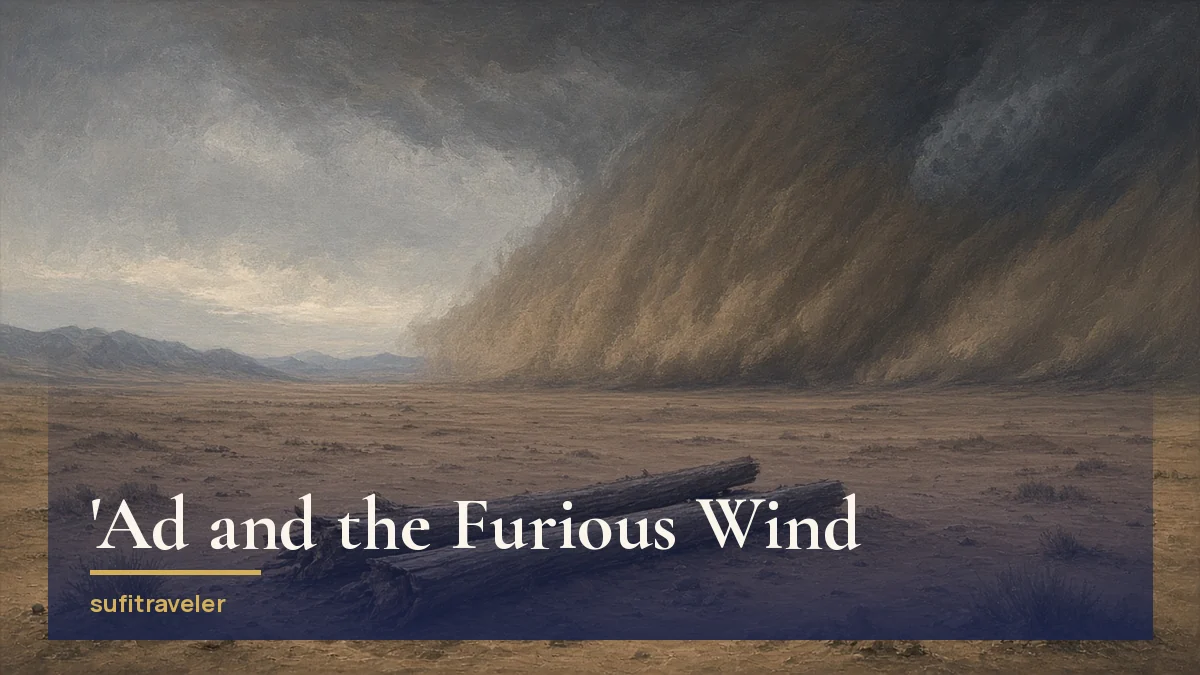
  • ‘Ad and the Furious Wind: Seven Nights and Eight Days in the Qur’an

    ‘Ad and the Furious Wind: Seven Nights and Eight Days in the Qur’an

    In our last story, the Prophet Hud, peace be upon him, called the people of ‘Ad to God, and they challenged him to bring the punishment he warned of. This story picks up where that one stopped: the wind.

    This is day eight of our Qur’an Stories series. The Arabic below is the Uthmani text. The English meanings are our own wording, and the commentary comes from Ibn Kathir. It is a reflection on meaning, not a ruling.

    Quick answer

    Short answer: ‘Ad saw a cloud coming towards their valleys and rejoiced, thinking it was rain (46:24). It was a cold, roaring wind that God set upon them for seven nights and eight days without a break (69:6-7), until only their dwellings were left standing (46:25).

    Where the wind is described

    • Al-Ahqaf: the cloud they mistook for rain (46:24-25).
    • Al-Haqqah: seven nights and eight days (69:6-8).
    • Fussilat: their boast, “Who is stronger than us?” (41:15).
    • Adh-Dhariyat: the barren wind (51:41-42).
    • Al-Qamar: a day of continuous calamity (54:18-20).

    “Who is stronger than us?”

    Before the wind came, the Qur’an names the root of the problem:

    فَأَمَّا عَادٌۭ فَٱسْتَكْبَرُوا۟ فِى ٱلْأَرْضِ بِغَيْرِ ٱلْحَقِّ وَقَالُوا۟ مَنْ أَشَدُّ مِنَّا قُوَّةً

    In meaning: as for ‘Ad, they were arrogant in the land without right, and said, “Who is stronger than us?” (41:15).

    A people who trusted in their own strength were undone by something they could not see: moving air.

    The cloud they welcomed

    فَلَمَّا رَأَوْهُ عَارِضًۭا مُّسْتَقْبِلَ أَوْدِيَتِهِمْ قَالُوا۟ هَٰذَا عَارِضٌۭ مُّمْطِرُنَا

    In meaning: when they saw it as a cloud spreading across the sky, heading for their valleys, they said, “This cloud will bring us rain” (46:24).

    Ibn Kathir, on 46:24, explains why they were glad: they had been suffering a drought and needed rain, so the sight of clouds made them happy. What looked like relief was the very punishment they had dared Hud to bring.

    Warning

    Ibn Kathir, on 46:21, also passes on reports about where ‘Ad lived, such as Qatadah’s report that they were a tribe in Yemen among the sand hills. We treat these as reports, not as part of the Qur’anic text.

    Seven nights and eight days

    سَخَّرَهَا عَلَيْهِمْ سَبْعَ لَيَالٍۢ وَثَمَٰنِيَةَ أَيَّامٍ حُسُومًۭا

    In meaning: He set it upon them for seven nights and eight days, without a break (69:7).

    Ibn Kathir, on 69:6-7, gathers the early explanations of three words:

    WordMeaning reported by Ibn Kathir
    ṣarṣar (صَرْصَر)Cold (Ad-Dahhak); Ibn Kathir himself glosses it as “a cold wind”
    ʿātiyah (عَاتِيَة)Blowing severely (Qatadah, As-Suddi and others), without mercy or blessing (Ad-Dahhak)
    ḥusūm (حُسُوم)In succession, without a break (Ibn Mas’ud, Ibn ‘Abbas, Mujahid and others)
    Three words in Al-Haqqah, from Ibn Kathir

    Under the same verse he cites the Prophet’s words, peace and blessings be upon him, as reported by Ibn ‘Abbas (Sahih al-Bukhari 1035; Sahih Muslim 900): “I was helped by the east wind, and ‘Ad were destroyed by the west wind.” The same air brought victory to one and ruin to others, by God’s command.

    A barren wind

    وَفِى عَادٍ إِذْ أَرْسَلْنَا عَلَيْهِمُ ٱلرِّيحَ ٱلْعَقِيمَ

    In meaning: in ‘Ad, too, there is a sign, when We sent against them the barren wind (51:41).

    Wind normally carries clouds and pollen and brings life. Ibn Kathir, on 51:41, reports from Ad-Dahhak and Qatadah that this wind was barren: it destroyed and produced nothing.

    Is any of them left?

    فَهَلْ تَرَىٰ لَهُم مِّنۢ بَاقِيَةٍۢ

    In meaning: do you see any trace of them remaining? (69:8). Surah al-Ahqaf ends the scene the same way: they became such that nothing could be seen except their homes (46:25). Surah al-Qamar calls it a day of continuous calamity (54:19), and then asks, in meaning, how was My punishment and My warning? (54:18).

    Reading these verses for yourself

    1

    Read 46:24-25 slowly and notice the moment hope turns to fear.

    2

    Read 69:6-8 and picture the seven nights and eight days.

    3

    Read 41:15 and ask where you rely on your own strength.

    4

    Finish with 54:17, which reminds you the Qur’an is made easy to remember.

    Lessons for the heart

    Reflections

    • What looks like rain may be a test, and what looks like hardship may be mercy.
    • Strength without humility is the boast of ‘Ad: “Who is stronger than us?”
    • Wind is a servant of its Lord. It moves “by the command of its Lord” (46:25).
    • Asking to hurry punishment is never wise. Ask instead for forgiveness, as Hud invited them to.

    Tip

    Read this story with the Hud story open alongside it. The call comes first, then the wind. Together they show how patient the warning was before the end came.

    Sources

    Arabic: quran-uthmani text from the alquran.cloud API, fetched 31 Oct 2026. Meanings are our own wording: 41:15, 46:24-25, 51:41-42, 54:18-20, 69:6-8.

    Commentary: Tafsir Ibn Kathir (Abridged, English), on 46:21, 46:24, 51:41 and 69:6-7 (Quran.com), read 31 Oct 2026.

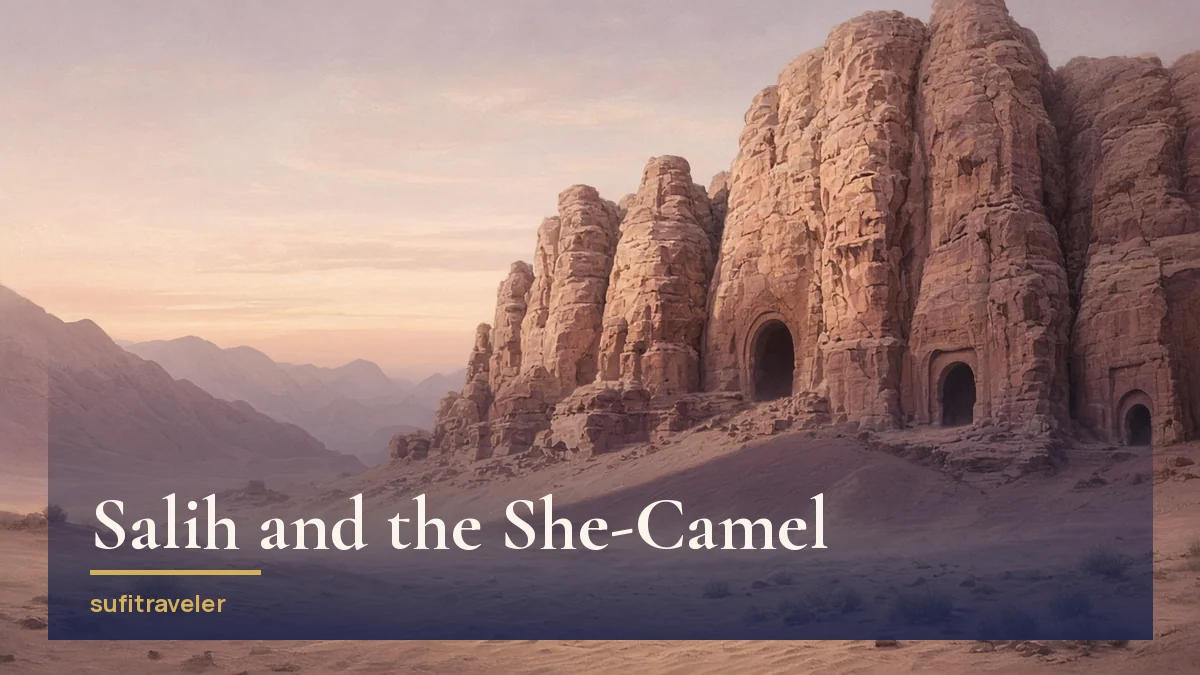
  • Prophet Salih and the She-Camel: Why Was It a Test?

    Prophet Salih and the She-Camel: Why Was It a Test?

    After ‘Ad came another strong nation: Thamud. They carved homes into mountains and lived among gardens and springs. God sent them their brother Salih, peace be upon him, and gave them a sign they could see with their own eyes: a she-camel.

    This is day nine of our Qur’an Stories series. Earlier we followed Prophet Hud and the people of ‘Ad. Here we ask a simple question: why was the she-camel a test? The English meanings below are our own wording. It is a reflection on meaning, not a ruling.

    Quick answer

    Short answer: Salih called Thamud to worship God alone (11:61). They asked for a sign, and God sent a she-camel with a share of water on fixed days (26:154-155). They were told not to harm her (7:73). The camel was a clear sign, and signs are sent as a warning (17:59).

    Where the story appears

    Where Salih appears in the Qur’an

    • Surah al-A’raf: Salih’s call and the sign of the she-camel (7:73-79).
    • Surah Hud: his hopes for his people and their doubt (11:61-68).
    • Surah ash-Shu’ara: their comforts, their demand for a sign and the shared water (26:141-159).
    • Surah al-Isra: the she-camel named as a visible sign (17:59).

    Who were Thamud?

    The Qur’an tells us that God made Thamud successors after ‘Ad and settled them in the land. They built palaces on its plains and carved houses out of the mountains (7:74). They had gardens, springs, crops and palms with soft, tender clusters (26:146-148).

    Salih reminded them that it was God who brought them out of the earth and settled them in it (11:61). Their skill was real, but it was a gift, not their own making alone.

    What did Salih ask of them?

    His message was the same as Hud’s before him: worship God, you have no god but Him. Ask His forgiveness and turn back to Him, for He is near and answers (11:61).

    Like every prophet, he asked no payment. In meaning (our words): I ask you for no reward for this; my reward is only with the Lord of the worlds (26:145). He also warned them not to obey the extravagant, who spread corruption and never set things right (26:151-152).

    Why did his people doubt him?

    Their answer is striking. They said, in meaning (our words): Salih, you were someone we looked to before this (11:62). They had placed their hopes in him. Now he was asking them to leave what their fathers worshipped, and they said they were in deep doubt about his call.

    They also called him bewitched and said he was only a man like them (26:153-154). Then they asked for proof: bring us a sign, if you are truthful.

    Why a she-camel?

    God answered their request. Salih said, in meaning (our words): this is the she-camel of God, a sign for you. Leave her to graze on God’s earth and do not touch her with harm, or a painful punishment will seize you (7:73, 11:64).

    She came with a rule. She would have her share of water, and they would have theirs, each on a known day (26:155). The Qur’an calls her a clear sign, and says signs are sent only to warn (17:59).

    They asked forThe test asked them to
    A visible sign (26:154)Believe what they had seen
    Proof of Salih’s truthLeave her free to graze (7:73)
    Something to settle their doubt (11:62)Share their water on fixed days (26:155)
    What they asked for and what the test asked of them

    What made it a test?

    Our reflection: the sign did not ask them to do anything hard. It asked them to hold back. Leave her alone. Share the water. Sometimes the real test is not doing more, but making room for what God has placed among us.

    The Qur’an also shows a split among the people. The proud chiefs asked the weaker believers whether they truly thought Salih was sent by his Lord. The believers said yes, they believed in his message. The proud said they rejected it (7:75-76).

    Tip

    A small habit from this story: when you ask God for a sign or an answer, be ready to act on it when it comes.

    How did it end?

    In one line: they hamstrung the camel and defied God’s command (7:77), and God saved Salih and the believers by His mercy (11:66). We tell what happened to Thamud in full in our next story.

    Lessons for the heart

    • Gifts point to the Giver. Homes, gardens and skill all came from God.
    • Signs bring responsibility. Asking for proof means being ready to follow it.
    • Restraint can be worship. The command was simply: do not harm her.
    • God is near. Salih told them, in meaning (our words): my Lord is near and answers (11:61).

    Sources

    Verse meanings are our own wording, cross-checked for sense against standard translations: 7:73-79, 11:61-68, 26:141-159 and 17:59.

  • Best Books on Sufism for Beginners: Six Classical Starting Points

    Best Books on Sufism for Beginners: Six Classical Starting Points

    There are thousands of books about Sufism, and many modern ones mix in ideas from outside Islam. A safer way to start is with the classical works the tradition itself has read and taught for centuries. Here are six good starting points, with a note on what each one is for. For a calm map of where to begin, see The Sufi Path: A Calm Start-Here Guide.

    Quick answer

    In short: start with Qushayri’s Risala or Hujwiri’s Kashf al-Mahjub for the basics, Ghazali for the link between law and the heart, Jilani and Ibn Ata’illah for short daily reading, and Rumi’s Masnavi once you know the foundations. Read slowly, ideally with a teacher.

    How we chose these books

    Each book below is a classical work, written by a respected classical scholar or teacher, and still widely read in the Muslim world. Each one roots Sufism in the Qur’an, the Sunnah and the Shariah. All are available in English translation. Please check that you are reading a careful, complete translation from a reputable publisher.

    Key takeaways

    • Six books, from the 11th to the 14th century.
    • Two handbooks, two short guides, one bridge book and one poem.
    • All available in English, in more than one translation.
    • Best read slowly, a few pages at a time.

    1. Al-Qushayri: the Risala

    Written in the 11th century, the Risala (Epistle) of Abu’l-Qasim al-Qushayri is one of the best-known handbooks of Sufism. It gives short lives of early Sufis and explains key terms such as repentance, patience and trust in God. English readers often use the translation by Alexander Knysh. Read our introduction to Qushayri’s Risala.

    2. Al-Hujwiri: Kashf al-Mahjub

    Kashf al-Mahjub (The Unveiling of the Veiled) is the earliest major Sufi treatise in Persian, completed in Lahore in about 1058. Al-Hujwiri writes like a teacher answering a student’s questions. The English translation by R. A. Nicholson (1911) is still widely used. See our introduction to Kashf al-Mahjub.

    3. Al-Ghazali: Deliverance from Error

    Imam al-Ghazali (died 1111) was a great scholar of law and theology. In al-Munqidh min al-Dalal (Deliverance from Error), a short book, he describes his own search for certainty and why he turned to the path of the Sufis. It is a good bridge for readers who come from a study of law or theology. His larger Ihya Ulum al-Din (Revival of the Religious Sciences) can follow later, one volume at a time.

    4. Abd al-Qadir al-Jilani: Futuh al-Ghayb

    Futuh al-Ghayb (Revelations of the Unseen) is a collection of short talks by Shaykh Abd al-Qadir al-Jilani of Baghdad (died 1166). The talks are direct and practical, on trust in God, patience and following the Shariah. They suit a few minutes of reading each day.

    5. Ibn Ata’illah: the Hikam

    The Hikam (Aphorisms) of Ibn Ata’illah al-Iskandari (died 1309) are short sayings on sincerity, reliance on God and the inner life. Each one can be read in a minute and thought about all day. Many teachers recommend reading it with a commentary or a teacher, as the lines are dense.

    6. Rumi: the Masnavi

    The Masnavi of Jalal al-Din Rumi (died 1273) is a long Persian poem full of stories and teaching. It is loved around the world, but many popular “Rumi quotes” online are loose versions or not from Rumi at all. Look for a careful translation, such as Nicholson’s. Our post on Rumi and Sufism explains more.

    Which book should you start with?

    If you want…Start with
    A clear overview of termsQushayri’s Risala
    A teacher’s voiceHujwiri’s Kashf al-Mahjub
    A personal story of searchingGhazali’s Deliverance from Error
    Short daily readingJilani’s Futuh al-Ghayb
    One line to reflect onIbn Ata’illah’s Hikam
    Stories and poetryRumi’s Masnavi
    Matching a book to the reader

    Tip

    Keep a small notebook while you read. Write down one idea per sitting and one way to practise it that day.

    Reading well

    Classical Sufi books were written for students who were already praying, fasting and learning the basics of the faith. Read them alongside your daily worship, not instead of it. Our guide on how to read classical Sufi texts has simple advice, and our library lists more titles.