Category: Sufi Masters

  • Shaykh Ahmad al-Rifa’i: The Humble Sufi of the Iraqi Marshes

    Shaykh Ahmad al-Rifa’i: The Humble Sufi of the Iraqi Marshes

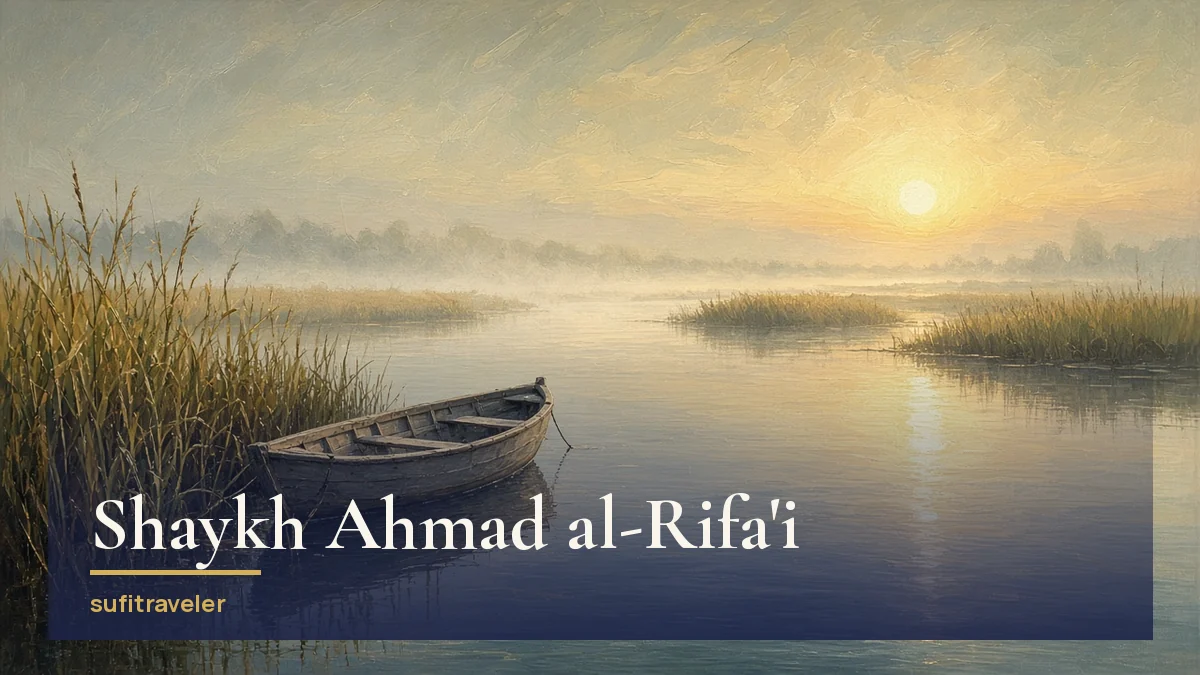
    In the marshlands of southern Iraq, in the 6th/12th century, lived a teacher whose name is still carried by Sufi circles from Iraq to Egypt, Turkey and South Asia. Shaykh Ahmad al-Rifa’i was a scholar and a guide, and above all he is remembered for humility.

    This post, part of our Sufism Basics series on the teachings page, keeps to what the sources broadly agree on and flags where accounts differ.

    Quick answer

    Short answer: Shaykh Ahmad al-Rifa’i (d. 578/1182) was a Sufi teacher and scholar from the Bata’ih, the marsh region near Wasit in southern Iraq. Trained in law and the religious sciences, he led a large community at Umm ‘Ubayda. He is remembered for humility, service and mercy to all creatures. The Rifa’i path (al-Rifa’iyya), one of the oldest Sufi orders, is named after him.

    His life in outline

    He was born in 512/1118 at Umm ‘Ubayda, in the Bata’ih marshes near Wasit. His father died when he was young, and he was raised with the help of his uncle, Shaykh Mansur al-Bata’ihi, himself a Sufi teacher.

    He studied the Qur’an and the religious sciences, and became a jurist of the Shafi’i school. Later he succeeded his uncle as guide of the community at Umm ‘Ubayda, where students and visitors gathered in large numbers. He died there in 578/1182.

    Key facts

    • Name: Ahmad ibn ‘Ali al-Rifa’i.
    • Lived: 512/1118 to 578/1182.
    • Born and taught: Umm ‘Ubayda, in the Bata’ih marshes near Wasit, southern Iraq.
    • School of law: Shafi’i.
    • Legacy: the Rifa’i Sufi path.

    A teacher known for humility

    Accounts of al-Rifa’i return again and again to one quality: he made himself small. He is described serving his guests, caring for the sick and the elderly, and refusing honour.

    That picture fits a description the Qur’an gives of the true servants of the Most Merciful (Qur’an 25:63).

    Qur’an 25:63:

    وَعِبَادُ الرَّحْمَٰنِ الَّذِينَ يَمْشُونَ عَلَى الْأَرْضِ هَوْنًا وَإِذَا خَاطَبَهُمُ الْجَاهِلُونَ قَالُوا سَلَامًا

    Meaning: the servants of the Most Merciful are those who walk on the earth gently and humbly, and when the ignorant address them, they reply with words of peace.

    Mercy to all creatures

    Many stories told about him show kindness to animals as well as people. One story told about him, which al-Dhahabi reports with the words “it is said” (Siyar A’lam al-Nubala’, 21:78), is that a cat fell asleep on his sleeve, and rather than wake it, he cut the sleeve away. We share it as a story told about him, not a confirmed event.

    Broadly agreedTold in later accounts
    LifeScholar and guide in southern IraqMany wonders and miracles
    CharacterHumility and serviceSpecific anecdotes, such as the cat
    LegacyThe Rifa’i pathDetails of early practice
    What we know and what is told

    The Rifa’i path

    The Sufi path named after him spread widely after his death, especially in Iraq, Syria, Egypt and the Ottoman lands. Like other orders, it centres on remembrance of God, guidance from a shaykh and good character. Over the centuries its branches developed their own practices, which scholars describe in different ways. Here we keep to the founder.

    Lessons from his example

    1

    Serve before you lead: he is remembered for serving guests himself.

    2

    Keep knowledge with humility: learning was joined with modesty.

    3

    Show mercy widely: to people, and to animals too.

    Tip

    New to Sufi history? Read our guide to Sufi terms for words like tariqa and shaykh.

    A note on quotes

    Many sayings circulate online under al-Rifa’i’s name without any book reference. We have not quoted them here. If we add a saying later, it will carry its primary source.

    FAQ

    Where is Shaykh Ahmad al-Rifa’i buried?

    He is buried at Umm ‘Ubayda, in southern Iraq, where he lived and taught.

    Which school of law did he follow?

    He is usually described as a Shafi’i jurist.

    Is the Rifa’i path still active?

    Yes. Branches of the Rifa’iyya continue in many countries today.

    Last checked: 24 October 2026 (Asia/Riyadh). Qur’an 25:63, meaning in our own words; Arabic checked by our reviewer. No sayings quoted. Educational introduction only.
  • Rumi and Sufism: The Scholar Behind the Masnavi, Gently Introduced

    Rumi and Sufism: The Scholar Behind the Masnavi, Gently Introduced

    Rumi may be the most quoted poet on social media today. Yet many of the lines shared under his name are not found in his works at all, and much of what is shared leaves out who he was: a Muslim scholar, a teacher of law and Qur’an, and a Sufi whose poetry grew from that faith.

    This post, part of our Sufism Basics series on the teachings page, introduces the man behind the verses.

    Quick answer

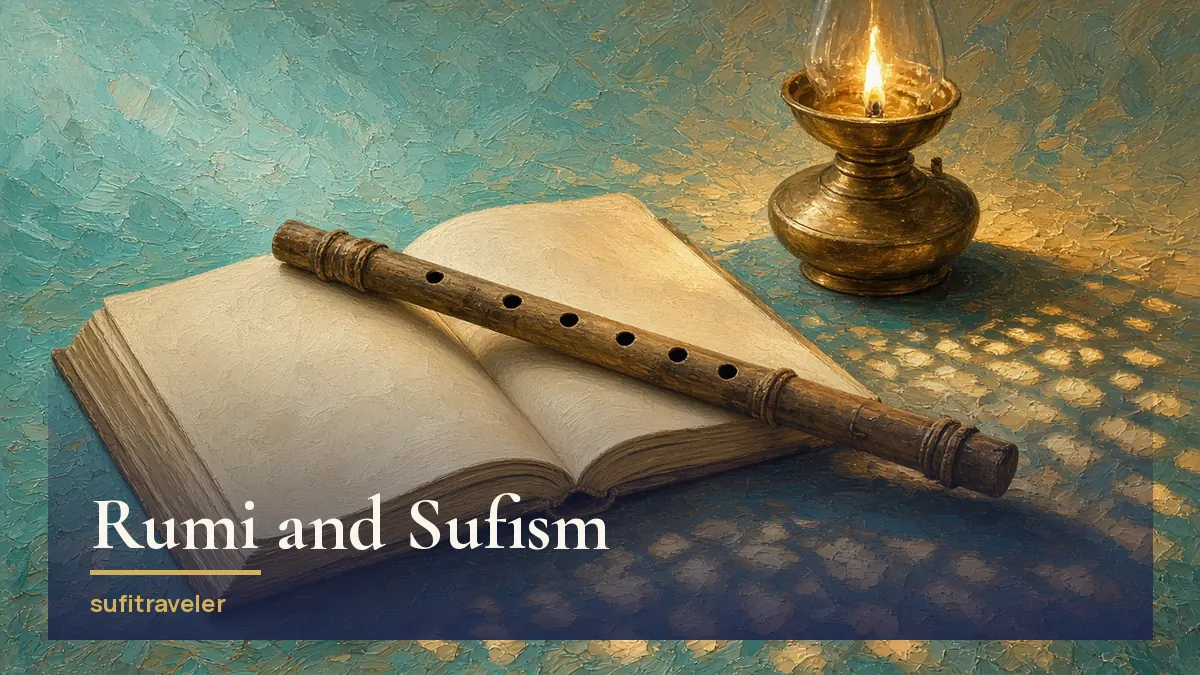
    Short answer: Mawlana Jalal al-Din Rumi (d. 672/1273) was a Muslim scholar and Sufi of Konya, in today’s Turkey. After meeting the wandering Sufi Shams of Tabriz, he turned to poetry of divine love. His Masnavi, a long poem in six books, is a classic of Sufi teaching. It opens with a reed flute lamenting its separation from the reed bed, a picture of the soul longing for its origin.

    Who was Rumi?

    Rumi was born around 604/1207 in the eastern lands of the Muslim world, in the region of Balkh. His father, Baha al-Din Walad, was a respected scholar and preacher. The family moved west, and eventually settled in Konya in Anatolia.

    There Rumi followed his father as a teacher. He taught the religious sciences and was known as a jurist and preacher before he was known as a poet. Admirers came to call him Mawlana, “our master”, which is why the order linked to him is called the Mawlawi, or Mevlevi.

    Key facts

    • Name: Jalal al-Din Muhammad, called Mawlana and Rumi (“of Rum”, Anatolia).
    • Lived: c. 604/1207 to 672/1273.
    • City: Konya, in today’s Turkey.
    • Turning point: meeting Shams of Tabriz (642/1244).
    • Best-known work: the Masnavi, in six books.

    The meeting with Shams

    In 642/1244 a wandering dervish, Shams al-Din of Tabriz, arrived in Konya. Some accounts suggest the two may first have met earlier, in Syria. His friendship with Rumi changed the scholar deeply. Accounts of their meeting are many and colourful, and historians treat a lot of them as later legend. What is clear is that, after Shams, Rumi’s love of God poured into poetry, first in the lyric poems later gathered as the Divan-i Shams, then in the Masnavi.

    The Masnavi and the song of the reed

    The Masnavi is a long poem in Persian, told in stories, parables and teachings. It is steeped in Qur’anic meanings.

    It opens with a reed flute. In E. H. Whinfield’s 1898 English version, the first lines read:

    “Hearken to the reed-flute, how it discourses When complaining of the pains of separation—” (Rumi, Masnavi, Book I, Prologue, p. 1, tr. E. H. Whinfield, London, 1898; scanned copy)

    The reed was cut from its reed bed, and its music is the sound of separation and longing to return. Sufi readers see in it the human soul, far from its Source and yearning for Him.

    Longing and return in the Qur’an

    That theme of return echoes a verse Muslims say at every loss (Qur’an 2:156).

    Qur’an 2:156 (excerpt):

    إِنَّا لِلَّهِ وَإِنَّا إِلَيْهِ رَاجِعُونَ

    Meaning: we belong to God, and to Him we are returning.

    What Rumi taught

    Three threads in Rumi’s teaching

    1

    Love of God: the heart’s longing for its Lord drives the path.

    2

    Breaking the ego: many stories in the Masnavi show pride and greed being humbled.

    3

    Living faith: prayer, the Qur’an and the Prophet ﷺ stay at the centre of his work.

    Popular imageHistorical Rumi
    IdentityA free-floating love poetA Muslim scholar and Sufi
    SourcesShort quotes onlineThe Masnavi and Divan
    FaithOften left outQur’an and Sunnah throughout
    Popular image and historical Rumi

    A word on “Rumi quotes”

    Many popular lines shared as Rumi’s cannot be traced to his works, or are loose rewrites. If a quote has no book or section reference, treat it with care. On this site we quote him only from a named, published translation.

    The Mevlevi order

    After Rumi’s death, his son Sultan Walad and his disciples formed the Mevlevi order, known for its music and its ceremony of remembrance. It later spread widely. Its history is rich, and this post keeps to an outline.

    Tip

    If Rumi draws you in, start with a reliable translation and an introduction to the wider tradition. Our library lists classical works, and our guide to Sufi terms explains words like shaykh and tariqa.

    FAQ

    Was Rumi a Muslim?

    Yes. He was a Muslim scholar who taught the religious sciences, and his poetry is full of the Qur’an and the Prophet ﷺ.

    What language did Rumi write in?

    Mostly Persian. Some lines are in Arabic and a few in Turkish and Greek.

    Is the Masnavi difficult to read?

    It is long, but it is built from stories, so it can be read a little at a time with a good introduction.

    Last checked: 24 October 2026 (Asia/Riyadh). Rumi quoted only from Whinfield’s 1898 translation (public domain). Qur’an 2:156, meaning in our own words; Arabic checked by our reviewer. Educational introduction only.