noah

  • The People of Nuh and the Flood: How the Qur’an Tells the Story

    The People of Nuh and the Flood: How the Qur’an Tells the Story

    For nine hundred and fifty years Nuh, peace be upon him, called his people, and most of them mocked him. The sky opened, the earth burst with springs, and a small ship carried a few believers through “waves like mountains”.

    This is day six of our Qur’an Stories series. The previous story covered Nuh’s call and the building of the Ark. This one follows the Flood itself, using the verses on Quran.com and the explanation of Ibn Kathir. It is a reflection on meaning, not a ruling.

    Quick answer

    Short answer: When God’s command came, Nuh was told to load “of each [creature] two mates and your family” and the believers, who were “a few” (11:40). His son refused to board and was drowned (11:42-43). Then the earth swallowed its water and the ship “came to rest on the [mountain of] Judiyy” (11:44). The Qur’an calls it “a sign for the worlds” (29:15).

    Where the story appears

    Where the Flood appears in the Qur’an

    • Surah Hud: the boarding, the son, al-Judi and Nuh’s plea for his son (11:40-48).
    • Surah al-Qamar: the gates of heaven, the springs and the ship of “planks and nails” (54:9-17).
    • Surah Nuh: Nuh’s final prayer against the deniers (71:25-28).
    • Surah ash-Shu’ara: “judge between me and them” and “the laden ship” (26:117-120).
    • Surah al-‘Ankabut: “a sign for the worlds” (29:14-15).

    “I am overpowered, so help”

    By the end, the people of Nuh had called him “a madman” and driven him back (54:9).

    So Nuh turned to his Lord with one of the shortest prayers in the Qur’an: “Indeed, I am overpowered, so help” (54:10). Ibn Kathir explains it as: I am weak and cannot resist my people, so help Your religion.

    The gates of heaven open

    The answer came in a single image. “Then We opened the gates of the heaven with rain pouring down, and caused the earth to burst with springs, and the waters met for a matter already predestined” (54:11-12).

    Surah Hud adds a sign: “the oven overflowed” (11:40). Ibn Kathir reports from Ibn ‘Abbas that the tannur here means the face of the earth. Water gushed from every place, even the places where fire was normally lit.

    Who boarded the Ark

    Nuh was told: “Load upon it of each [creature] two mates and your family, except those about whom the word has preceded, and [include] whoever has believed.” Then the verse adds, simply: “But none had believed with him, except a few” (11:40).

    As they boarded, Nuh said: “Embark therein; in the name of Allah [are] its course and its anchorage” (11:41). Surah al-Qamar calls the ship “a [construction of] planks and nails”, sailing “under Our observation” (54:13-14).

    The son who stayed behind

    The most painful moment of the story is a conversation between a father and his son. “It sailed with them through waves like mountains, and Noah called to his son who was apart [from them], ‘O my son, come aboard with us and be not with the disbelievers’” (11:42).

    The son answered: “I will take refuge on a mountain to protect me from the water.” Nuh replied: “There is no protector today from the decree of Allah, except for whom He gives mercy.” Then “the waves came between them, and he was among the drowned” (11:43).

    Ibn Kathir notes that the “family” excepted in 11:40 were those of Nuh’s household who did not believe, among them this son and Nuh’s wife. The Qur’an itself names the wife of Nuh as an example of those who disbelieved (66:10).

    The water subsides and the ship rests

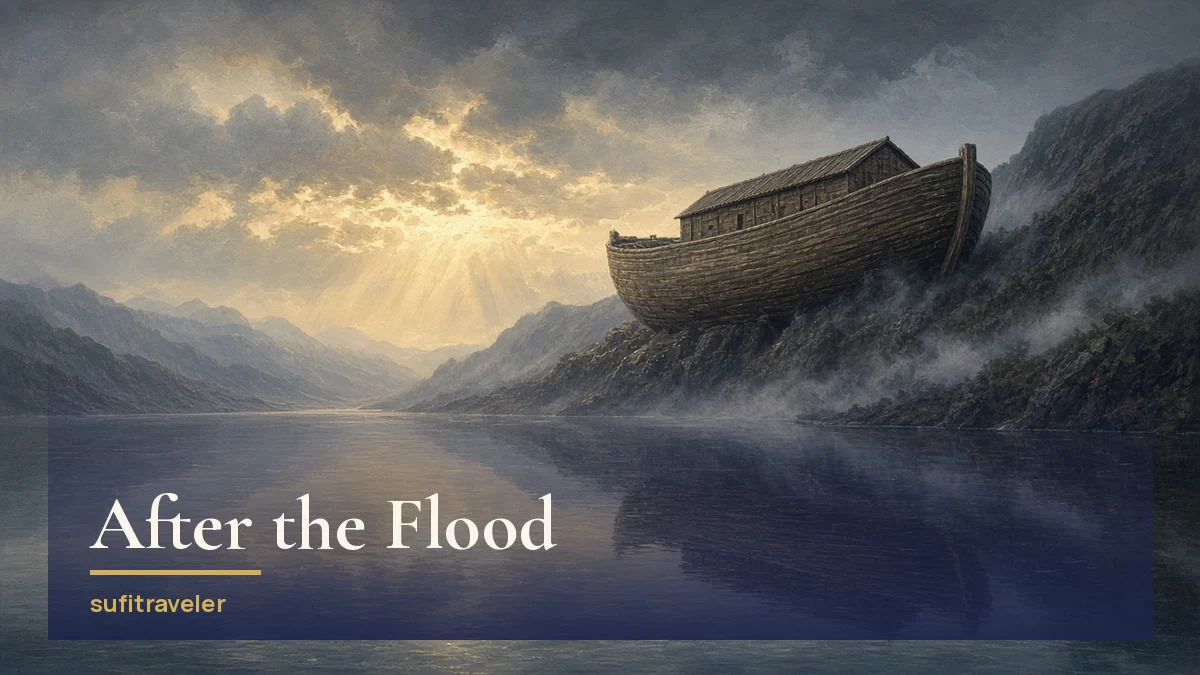
    Then came the end of the Flood. “O earth, swallow your water, and O sky, withhold [your rain].” The water subsided, “the matter was accomplished”, and the ship “came to rest on the [mountain of] Judiyy. And it was said, ‘Away with the wrongdoing people’” (11:44).

    Ibn Kathir passes on a saying from Mujahid that al-Judi is a mountain in al-Jazirah, the upper Mesopotamia region. The Qur’an names the mountain but does not say where it is.

    “He is not of your family”

    After the Flood, Nuh spoke to his Lord about his son. “My Lord, indeed my son is of my family; and indeed, Your promise is true; and You are the most just of judges” (11:45).

    The answer was firm and gentle at once: “O Noah, indeed he is not of your family; indeed, he is [one whose] work was other than righteous, so ask Me not for that about which you have no knowledge” (11:46).

    Ibn Kathir explains that the promise was to save those of Nuh’s family who believed. He reports from Ibn ‘Abbas that the boy was truly Nuh’s son, but opposed him in deeds and intention. Nuh at once sought refuge and forgiveness (11:47), and was told to “disembark in security” (11:48).

    Close by bloodClose by faith
    WhoNuh’s son and wifeThe few who believed
    What they didRefused the callBoarded with Nuh
    Outcome in the versesAmong the drowned (11:43)Saved in the ship (26:119)
    Two kinds of closeness in the story

    Nuh’s final prayer

    Surah Nuh records his prayer as the story closed. The deniers “were drowned and put into the Fire, and they found not for themselves besides Allah [any] helpers” (71:25).

    Nuh asked that none of the deniers be left on the earth, “if You leave them, they will mislead Your servants” (71:26-27). Ibn Kathir says Nuh said this from what he knew of them after nine and a half centuries. He closed with a prayer of forgiveness for “the believing men and believing women” (71:28).

    Warning

    A note on disputed reports. Ibn Kathir passes on a report from Ibn ‘Abbas that about eighty people were on board, and names the son as Yam. Some reports mention which birds and animals boarded first and last, and some say the Ark stayed visible on al-Judi for early generations. The Qur’an says only “a few” and gives no names or numbers. Scholars also differ on how far the Flood reached. These details are reports, some from earlier scriptures (Isra’iliyyat), and we mention them only as reports, not as fact.

    Lessons for the heart

    • Mockery doesn’t delay God’s decree. The chiefs laughed at a ship on dry land until the water came.
    • Kinship can’t save the one who refuses. Even a prophet’s son was “among the drowned”.
    • Turn to God in weakness. “I am overpowered, so help” is a prayer anyone can make.

    What comes next

    The series moves on to the nations that came after Nuh. Until then, browse the Qur’an Stories series.
    Sources

    Verse wording: Saheeh International, ranges linked above, each opened 28 Oct 2026: 11:36-48, 54:9-17, 71:21-27 (with 71:28), 26:116-120, 29:14-15 and 66:10. Tafsir: Ibn Kathir on 11:40, 11:44, 11:45, 54:11 and 71:26.

  • Prophet Nuh and the Ark: 950 Years of Calling His People to God

    Prophet Nuh and the Ark: 950 Years of Calling His People to God

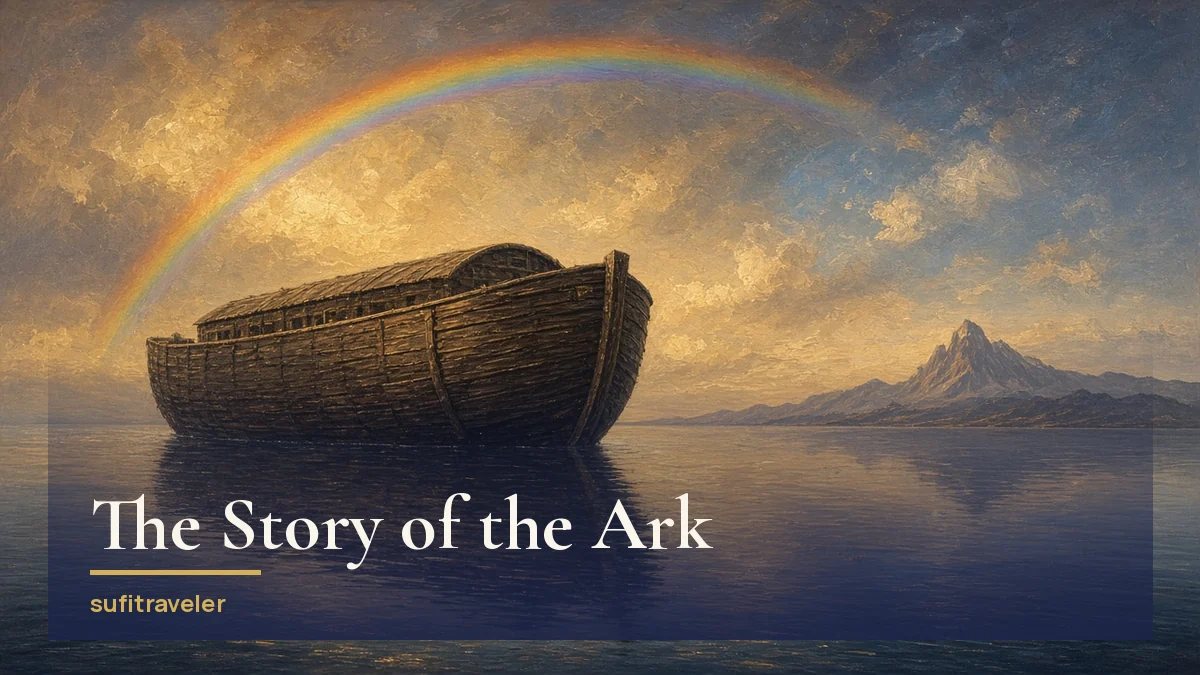
    Nuh, peace be upon him, called his people to worship God alone for nearly a thousand years. He spoke to them in public and in private, by night and by day. Most of them turned away. Then God told him to build a ship on dry land, and the mockery only grew louder.

    This is day five of our Qur’an Stories series. We follow the verses on Quran.com and the explanation of Ibn Kathir. This post covers Nuh’s call and the building of the Ark. The Flood itself is the next story in the series. This is a reflection on meaning, not a ruling.

    Quick answer

    Short answer: The Qur’an says Nuh “remained among them a thousand years minus fifty years” (29:14), calling his people “night and day” (71:5). Their leaders called him “a man like ourselves” and mocked his followers (11:27). God then revealed that no more of them would believe, and told him: “construct the ship under Our observation and Our inspiration” (11:37).

    Where the story appears

    Key passages

    • Surah Nuh: his whole method of calling, in his own words (71:1-12) and his complaint to God (71:21-24).
    • Surah Hud: the argument with the leaders (11:25-28, 11:32-34) and the building of the Ark (11:36-39).
    • Surah ash-Shu’ara: “I do not ask you for it any payment” (26:105-118).
    • Surah al-Mu’minun: “if Allah had willed… He would have sent down angels” (23:23-24).
    • Length of his mission: “a thousand years minus fifty years” (29:14).

    The call: night and day, open and secret

    Surah Nuh opens with God sending Nuh to “warn your people before there comes to them a painful punishment” (71:1). His message was simple: “worship Allah, fear Him and obey me”, with a promise attached: “He will forgive you of your sins” (71:3-4).

    Then Nuh tells God, in his own words, how he went about it. “My Lord, indeed I invited my people night and day. But my invitation increased them not except in flight” (71:5-6). Every time he called them, “they put their fingers in their ears, covered themselves with their garments, persisted, and were arrogant” (71:7). So he changed his approach. “Then I invited them publicly. Then I announced to them and also confided to them secretly” (71:8-9).

    He even spoke to their worldly hopes: ask forgiveness, and God would “send rain from the sky upon you” and “give you increase in wealth and children” (71:10-12).

    Ibn Kathir explains that Nuh “presented the clear call… and the comprehensive invitation in various ways”, sometimes by encouragement and sometimes by warning. Nuh adapted his method; he never changed his message.

    The leaders’ objections

    The Qur’an gives the chiefs’ arguments in their own words, and they still sound familiar. “We do not see you but as a man like ourselves,” they said, “and we do not see you followed except by those who are the lowest of us” (11:27). Elsewhere: “if Allah had willed to send a messenger, He would have sent down angels. We have not heard of this among our forefathers” (23:24).

    Nuh’s answer was gentle and firm. He would not drive away the poor believers: “I am not one to drive away the believers. I am only a clear warner” (26:114-115). He asked them for nothing: “I do not ask you for it any payment. My payment is only from the Lord of the worlds” (26:109). He would not force faith on anyone: “should we force it upon you while you are averse to it?” (11:28).

    In the end the leaders dared him: “bring us what you threaten us, if you should be of the truthful” (11:32). They threatened him too: “If you do not desist, O Noah, you will surely be of those who are stoned” (26:116).

    The idols of Nuh’s people

    Nuh’s complaint names the idols his people refused to leave: “Never leave Wadd or Suwa’ or Yaghuth and Ya’uq and Nasr” (71:23). Ibn Kathir cites a report in Sahih al-Bukhari from Ibn ‘Abbas (Bukhari 4920): these “were all named after righteous men from the people of Nuh”. After those men died, people made images to remember them, and later generations came to worship them.

    The worship of idols began not with hatred of good people but with exaggerated love for them.

    950 years

    Surah al-‘Ankabut says Nuh “remained among them a thousand years minus fifty years” (29:14). Ibn Kathir explains that God told this to the Prophet Muhammad, peace be upon him, as consolation. If Nuh kept calling for so long with so few responding, a caller today shouldn’t despair at slow results.

    Ibn Kathir also reports a view from Ibn ‘Abbas that Nuh was sent at forty and lived some years after the Flood. Scholars report different figures for his total age. The Qur’an’s own figure is the time he spent among his people, and that is the one we rely on here.

    “Construct the ship”

    At last the waiting ended. God revealed: “No one will believe from your people except those who have already believed, so do not be distressed by what they have been doing. And construct the ship under Our observation and Our inspiration” (11:36-37). Ibn Kathir explains “under Our eyes” as “under Our vision”, and “Our revelation” as “We will teach you what to do”.

    So Nuh built a ship far from any sea. “Whenever an assembly of the eminent of his people passed by him, they ridiculed him.” He replied: “If you ridicule us, then we will ridicule you just as you ridicule. And you are going to know who will get a punishment that will disgrace him” (11:38-39).

    Warning

    A note on reports. Ibn Kathir passes on a report from Muhammad ibn Ishaq, “from the Tawrah”, giving the Ark’s wood, its measurements in cubits and three decks. Reports like this come from earlier scriptures (Isra’iliyyat). Scholars treat them as neither confirmed nor denied, and the Qur’an gives no measurements. We mention it only as a report, not as fact.

    Lessons for the heart

    • Keep calling, change the method. Nuh tried public and private, hope and warning.
    • Don’t measure truth by who follows it. The chiefs mocked the believers for being poor, and Nuh refused to turn them away.
    • Sincerity asks for nothing. “My payment is only from the Lord of the worlds.”

    What comes next

    The next story in the series turns to the Flood itself: the boarding, Nuh’s son, and the ship coming to rest. Until then, browse the full Qur’an Stories series, or go back to the first story, Iblis and Adam.

    Sources

    Verse wording: Saheeh International, ranges linked above, checked 25 Oct 2026. Tafsir: Ibn Kathir on 11:37, 29:14 and 71:23. Hadith: Sahih al-Bukhari 4920.