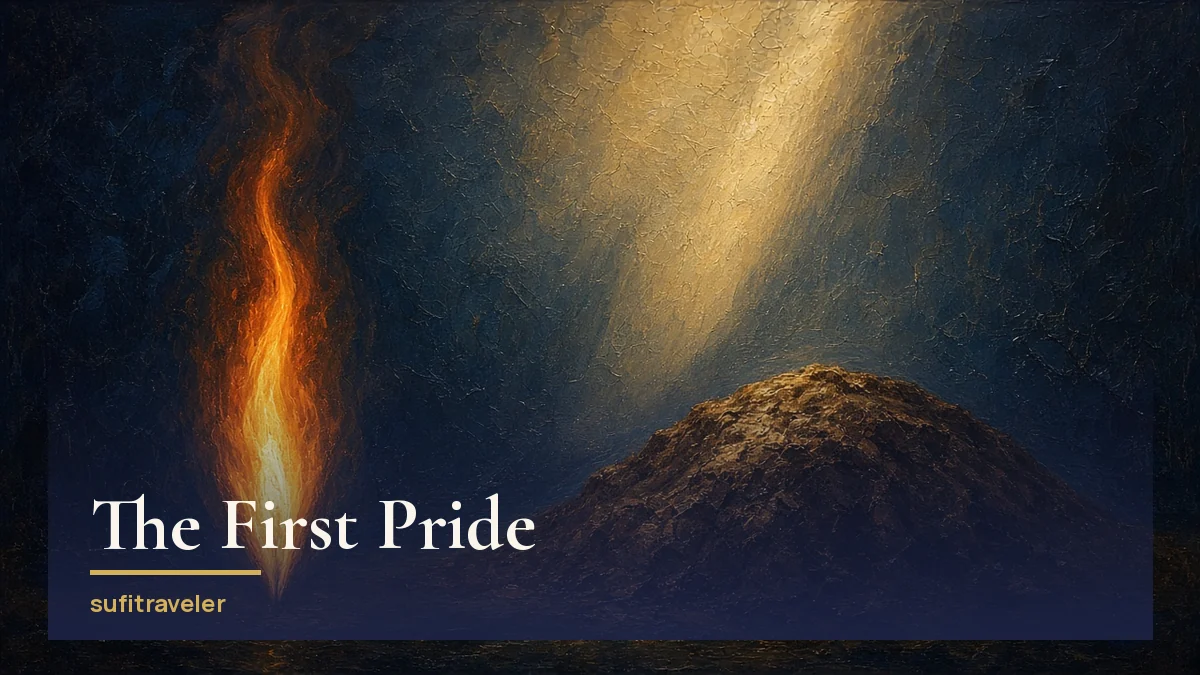
The story of Iblis and Adam is one of the most repeated scenes in the Qur’an. It appears in at least six surahs, each time from a slightly different angle. At its heart is a single moment: a command from God, the angels obeying, and one being who refuses.
This is day one of our Qur’an Stories series. We read the verses on Quran.com and follow the explanation of the classical scholar Ibn Kathir. This is a reflection on meaning, not a ruling.
Quick answer
Short answer: God told the angels He would place a successor on earth, taught Adam the names, and commanded the angels to prostrate to him. All of them did “except for Iblees. He refused and was arrogant and became of the disbelievers” (Qur’an 2:34, Saheeh International). Iblis claimed he was better because he was made from fire, and he was expelled.
Where the story appears in the Qur’an
Each passage adds a detail.
Key takeaways
- The announcement and the names: 2:30-34, in Surah al-Baqarah.
- Iblis’s argument and his vow: 7:11-18, in Surah al-A’raf.
- Clay, the breath of life, and the reprieve: 15:28-44, in Surah al-Hijr.
- “Whom You have honored above me”: 17:61-65, in Surah al-Isra’.
- “He was of the jinn”: 18:50, in Surah al-Kahf.
- “Created with My hands”: 38:71-85, in Surah Sad.
The announcement to the angels
The story begins before Adam is created. In 2:30, God says to the angels, “Indeed, I will make upon the earth a successive authority.” The angels ask, “Will You place upon it one who causes corruption therein and sheds blood, while we exalt You with praise and declare Your perfection?”
God answers simply: “Indeed, I know that which you do not know.” Ibn Kathir explains in his tafsir of 2:30 that the angels’ question was a request to understand the wisdom, not an objection to God.
Adam is taught the names
Next, God “taught Adam the names, all of them” (2:31). Asked to name these things, the angels reply: “Exalted are You; we have no knowledge except what You have taught us.”
Scholars differ on exactly what “the names” covered. Ibn Kathir reports the view that it included the names of all things, great and small.
The command and the refusal
In Surah al-Hijr and Surah Sad, God says He will create a human being from clay, and that once He has “proportioned him and breathed into him of My [created] soul,” the angels are to “fall down to him in prostration” (15:28-29, 38:71-72).
“So the angels prostrated, all of them entirely, except Iblees” (15:30-31). Ibn Kathir notes in his tafsir of 18:50 that this was a prostration of respect and honour for Adam, while the obedience itself was to God.
Was Iblis an angel?
The Qur’an says plainly that Iblis “was of the jinn” (18:50). Scholars differ on how he came to be among the angels when the command was given. Ibn Kathir’s view, in his tafsir of 2:34, is that he was not an angel but imitated their worship, so he was included in the command.
“I am better than him”
God asks Iblis directly: “What prevented you from prostrating when I commanded you?” His answer is the root of the whole story: “I am better than him. You created me from fire and created him from clay” (7:12).
Ibn Kathir points out that this was a false comparison. Clay, he writes, carries patience, steadiness and growth, while fire carries haste and burning.
| The angels | Iblis | |
|---|---|---|
| First reaction | Asked to understand, then said “we have no knowledge except what You have taught us” | Refused |
| Reason given | Trust in God’s knowledge | “I am better than him” |
| Root | Humility | Pride (kibr) |
| Outcome | Honoured | Expelled and cursed until the Day of Recompense |
Expelled, reprieved, and a vow
God commands Iblis to leave: “Descend from it, for it is not for you to be arrogant therein. So get out; indeed, you are of the debased” (7:13). Iblis does not repent. Instead he asks for a delay “until the Day they are resurrected,” and it is granted until “the Day of the time well-known” (15:36-38).
He then makes his vow. He will sit in wait on the straight path and come at people “from before them and from behind them and on their right and on their left” (7:16-17). In Surah Sad he swears, “By Your might, I will surely mislead them all, except, among them, Your chosen servants” (38:82-83).
The promise of protection
The story does not end with Iblis’s threat. It ends with God’s answer. “Indeed, My servants, no authority will you have over them, except those who follow you of the deviators” (15:42). Surah al-Kahf then asks the reader directly: “Will you take him and his descendants as allies other than Me while they are enemies to you?” (18:50).
What we leave out
Older books add names and details about Iblis drawn from Israiliyat (reports from earlier traditions) that cannot be confirmed. This series keeps to what the Qur’an says and what Ibn Kathir explains from it.
Lessons for the traveller of the heart
Pride was the first sin. It began quietly, with a comparison: “I am better than him.”
Four reflections from the story
1
Notice comparison: pride often starts with measuring yourself against someone else.
2
Ask like the angels: questions asked to understand are not the same as refusal.
3
Say “we have no knowledge except what You have taught us”: humility about what we know keeps the heart soft.
4
Turn back quickly: Iblis was given time but did not repent; in the next story, Adam slips and does. For more, see our post on repentance (tawba).
Tip
Before reading the next story, try a short evening muhasaba: where today did I think “I am better than him”?
FAQ
Where is the story of Iblis and Adam in the Qur’an?
The main passages are 2:30-34, 7:11-18, 15:28-44, 17:61-65, 18:50 and 38:71-85.
Why did Iblis refuse to prostrate?
Out of pride. He said, “I am better than him. You created me from fire and created him from clay” (7:12).
Last checked: 23 October 2026 (Asia/Riyadh) against Qur’an 2:30-34, 7:11-18, 15:28-44, 17:61-65, 18:50 and 38:71-85 (Saheeh International translation) and Tafsir Ibn Kathir (Abridged) for 2:30, 2:34, 7:12 and 18:50. Educational reflection only, not a religious ruling.
Sources
- https://quran.com/2/30-34
- https://quran.com/7/11-18
- https://quran.com/15/28-44
- https://quran.com/17/61-65
- https://quran.com/18/50
- https://quran.com/38/71-85
- https://quran.com/2:30/tafsirs/en-tafisr-ibn-kathir
- https://quran.com/2:34/tafsirs/en-tafisr-ibn-kathir
- https://quran.com/18:50/tafsirs/en-tafisr-ibn-kathir
- https://quran.com/38:71/tafsirs/en-tafisr-ibn-kathir
Comments
2 responses to “Iblis Refuses to Bow to Adam: The Qur’an’s First Story of Pride”
[…] is day two of our Qur’an Stories series. Day one told how Iblis refused to bow to Adam out of pride. We read the verses on Quran.com in the Saheeh […]
[…] The next story in the series turns to the Flood itself: the boarding, Nuh’s son, and the ship coming to rest. Until then, browse the full Qur’an Stories series, or go back to the first story, Iblis and Adam. […]