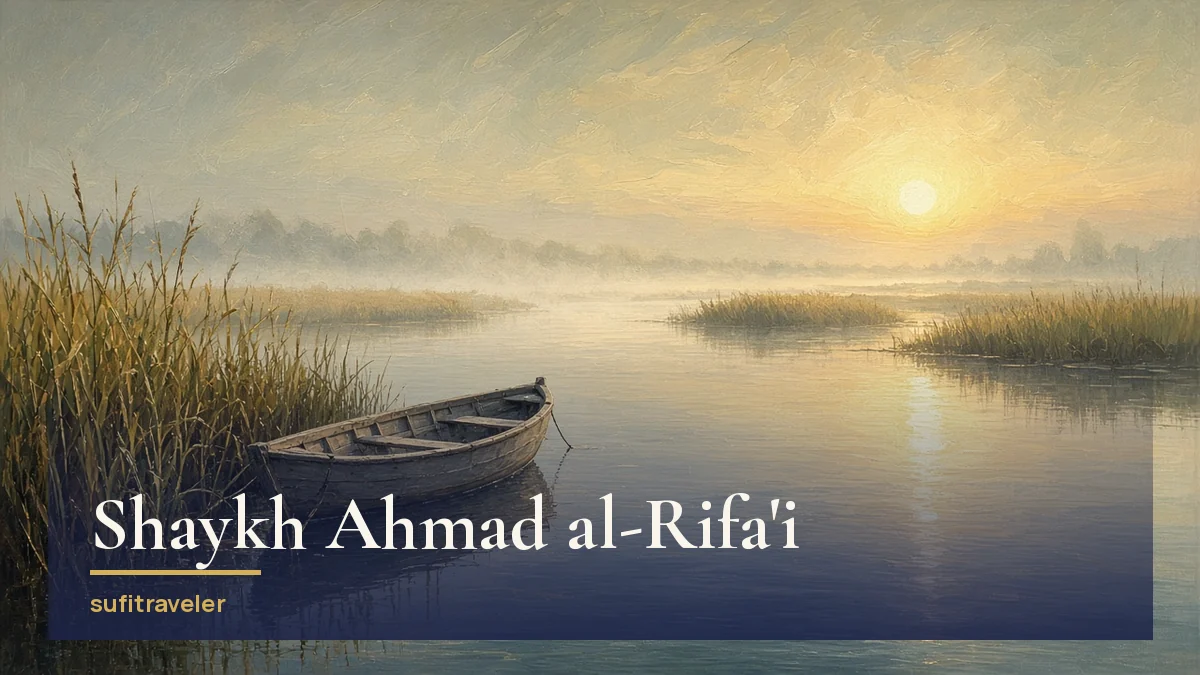
In the marshlands of southern Iraq, in the 6th/12th century, lived a teacher whose name is still carried by Sufi circles from Iraq to Egypt, Turkey and South Asia. Shaykh Ahmad al-Rifa’i was a scholar and a guide, and above all he is remembered for humility.
This post, part of our Sufism Basics series on the teachings page, keeps to what the sources broadly agree on and flags where accounts differ.
Quick answer
Short answer: Shaykh Ahmad al-Rifa’i (d. 578/1182) was a Sufi teacher and scholar from the Bata’ih, the marsh region near Wasit in southern Iraq. Trained in law and the religious sciences, he led a large community at Umm ‘Ubayda. He is remembered for humility, service and mercy to all creatures. The Rifa’i path (al-Rifa’iyya), one of the oldest Sufi orders, is named after him.
His life in outline
He was born in 512/1118 at Umm ‘Ubayda, in the Bata’ih marshes near Wasit. His father died when he was young, and he was raised with the help of his uncle, Shaykh Mansur al-Bata’ihi, himself a Sufi teacher.
He studied the Qur’an and the religious sciences, and became a jurist of the Shafi’i school. Later he succeeded his uncle as guide of the community at Umm ‘Ubayda, where students and visitors gathered in large numbers. He died there in 578/1182.
Key facts
- Name: Ahmad ibn ‘Ali al-Rifa’i.
- Lived: 512/1118 to 578/1182.
- Born and taught: Umm ‘Ubayda, in the Bata’ih marshes near Wasit, southern Iraq.
- School of law: Shafi’i.
- Legacy: the Rifa’i Sufi path.
A teacher known for humility
Accounts of al-Rifa’i return again and again to one quality: he made himself small. He is described serving his guests, caring for the sick and the elderly, and refusing honour.
That picture fits a description the Qur’an gives of the true servants of the Most Merciful (Qur’an 25:63).
Qur’an 25:63:
وَعِبَادُ الرَّحْمَٰنِ الَّذِينَ يَمْشُونَ عَلَى الْأَرْضِ هَوْنًا وَإِذَا خَاطَبَهُمُ الْجَاهِلُونَ قَالُوا سَلَامًا
Meaning: the servants of the Most Merciful are those who walk on the earth gently and humbly, and when the ignorant address them, they reply with words of peace.
Mercy to all creatures
Many stories told about him show kindness to animals as well as people. One story told about him, which al-Dhahabi reports with the words “it is said” (Siyar A’lam al-Nubala’, 21:78), is that a cat fell asleep on his sleeve, and rather than wake it, he cut the sleeve away. We share it as a story told about him, not a confirmed event.
| Broadly agreed | Told in later accounts | |
|---|---|---|
| Life | Scholar and guide in southern Iraq | Many wonders and miracles |
| Character | Humility and service | Specific anecdotes, such as the cat |
| Legacy | The Rifa’i path | Details of early practice |
The Rifa’i path
The Sufi path named after him spread widely after his death, especially in Iraq, Syria, Egypt and the Ottoman lands. Like other orders, it centres on remembrance of God, guidance from a shaykh and good character. Over the centuries its branches developed their own practices, which scholars describe in different ways. Here we keep to the founder.
Lessons from his example
1
Serve before you lead: he is remembered for serving guests himself.
2
Keep knowledge with humility: learning was joined with modesty.
3
Show mercy widely: to people, and to animals too.
Tip
New to Sufi history? Read our guide to Sufi terms for words like tariqa and shaykh.
A note on quotes
Many sayings circulate online under al-Rifa’i’s name without any book reference. We have not quoted them here. If we add a saying later, it will carry its primary source.
FAQ
Where is Shaykh Ahmad al-Rifa’i buried?
He is buried at Umm ‘Ubayda, in southern Iraq, where he lived and taught.
Which school of law did he follow?
He is usually described as a Shafi’i jurist.
Is the Rifa’i path still active?
Yes. Branches of the Rifa’iyya continue in many countries today.
Last checked: 24 October 2026 (Asia/Riyadh). Qur’an 25:63, meaning in our own words; Arabic checked by our reviewer. No sayings quoted. Educational introduction only.
Leave a Reply