Tag: humility

  • Shaykh Ahmad al-Rifa’i: The Humble Sufi of the Iraqi Marshes

    Shaykh Ahmad al-Rifa’i: The Humble Sufi of the Iraqi Marshes

    In the marshlands of southern Iraq, in the 6th/12th century, lived a teacher whose name is still carried by Sufi circles from Iraq to Egypt, Turkey and South Asia. Shaykh Ahmad al-Rifa’i was a scholar and a guide, and above all he is remembered for humility.

    This post, part of our Sufism Basics series on the teachings page, keeps to what the sources broadly agree on and flags where accounts differ.

    Quick answer

    Short answer: Shaykh Ahmad al-Rifa’i (d. 578/1182) was a Sufi teacher and scholar from the Bata’ih, the marsh region near Wasit in southern Iraq. Trained in law and the religious sciences, he led a large community at Umm ‘Ubayda. He is remembered for humility, service and mercy to all creatures. The Rifa’i path (al-Rifa’iyya), one of the oldest Sufi orders, is named after him.

    His life in outline

    He was born in 512/1118 at Umm ‘Ubayda, in the Bata’ih marshes near Wasit. His father died when he was young, and he was raised with the help of his uncle, Shaykh Mansur al-Bata’ihi, himself a Sufi teacher.

    He studied the Qur’an and the religious sciences, and became a jurist of the Shafi’i school. Later he succeeded his uncle as guide of the community at Umm ‘Ubayda, where students and visitors gathered in large numbers. He died there in 578/1182.

    Key facts

    • Name: Ahmad ibn ‘Ali al-Rifa’i.
    • Lived: 512/1118 to 578/1182.
    • Born and taught: Umm ‘Ubayda, in the Bata’ih marshes near Wasit, southern Iraq.
    • School of law: Shafi’i.
    • Legacy: the Rifa’i Sufi path.

    A teacher known for humility

    Accounts of al-Rifa’i return again and again to one quality: he made himself small. He is described serving his guests, caring for the sick and the elderly, and refusing honour.

    That picture fits a description the Qur’an gives of the true servants of the Most Merciful (Qur’an 25:63).

    Qur’an 25:63:

    وَعِبَادُ الرَّحْمَٰنِ الَّذِينَ يَمْشُونَ عَلَى الْأَرْضِ هَوْنًا وَإِذَا خَاطَبَهُمُ الْجَاهِلُونَ قَالُوا سَلَامًا

    Meaning: the servants of the Most Merciful are those who walk on the earth gently and humbly, and when the ignorant address them, they reply with words of peace.

    Mercy to all creatures

    Many stories told about him show kindness to animals as well as people. One story told about him, which al-Dhahabi reports with the words “it is said” (Siyar A’lam al-Nubala’, 21:78), is that a cat fell asleep on his sleeve, and rather than wake it, he cut the sleeve away. We share it as a story told about him, not a confirmed event.

    Broadly agreedTold in later accounts
    LifeScholar and guide in southern IraqMany wonders and miracles
    CharacterHumility and serviceSpecific anecdotes, such as the cat
    LegacyThe Rifa’i pathDetails of early practice
    What we know and what is told

    The Rifa’i path

    The Sufi path named after him spread widely after his death, especially in Iraq, Syria, Egypt and the Ottoman lands. Like other orders, it centres on remembrance of God, guidance from a shaykh and good character. Over the centuries its branches developed their own practices, which scholars describe in different ways. Here we keep to the founder.

    Lessons from his example

    1

    Serve before you lead: he is remembered for serving guests himself.

    2

    Keep knowledge with humility: learning was joined with modesty.

    3

    Show mercy widely: to people, and to animals too.

    Tip

    New to Sufi history? Read our guide to Sufi terms for words like tariqa and shaykh.

    A note on quotes

    Many sayings circulate online under al-Rifa’i’s name without any book reference. We have not quoted them here. If we add a saying later, it will carry its primary source.

    FAQ

    Where is Shaykh Ahmad al-Rifa’i buried?

    He is buried at Umm ‘Ubayda, in southern Iraq, where he lived and taught.

    Which school of law did he follow?

    He is usually described as a Shafi’i jurist.

    Is the Rifa’i path still active?

    Yes. Branches of the Rifa’iyya continue in many countries today.

    Last checked: 24 October 2026 (Asia/Riyadh). Qur’an 25:63, meaning in our own words; Arabic checked by our reviewer. No sayings quoted. Educational introduction only.

  • The Dua of Yunus in the Qur’an: A Reflection on 21:87-88

    The Dua of Yunus in the Qur’an: A Reflection on 21:87-88

    Some duas in the Qur’an are long. The one associated with the Prophet Yunus (peace be upon him) is very short, and many Muslims know it by heart. It is a sentence of praise and honest admission, spoken from the deepest kind of darkness.

    This post reads the verses where it appears, two related passages, and two hadith with their gradings as listed on Sunnah.com. It is a reflection on meaning and practice, not a ruling.

    Quick answer

    Short answer: In Qur’an 21:87, Yunus, called “the man of the fish”, calls out within the darknesses: “There is no deity except You; exalted are You. Indeed, I have been of the wrongdoers.” The next verse says Allah responded to him and saved him from distress, “and thus do We save the believers” (Saheeh International translation).

    What the verses say

    Surah al-Anbiya mentions Yunus as Dhun-Nun, “the man of the fish”. Verse 21:87 says he “went off in anger” and then “called out within the darknesses”.

    The words of his call, as given in the Arabic text on Quran.com, are:

    لَّآ إِلَـٰهَ إِلَّآ أَنتَ سُبْحَـٰنَكَ إِنِّى كُنتُ مِنَ ٱلظَّـٰلِمِينَ

    Lā ilāha illā anta subḥānaka innī kuntu mina ẓ-ẓālimīn: “There is no deity except You; exalted are You. Indeed, I have been of the wrongdoers.”

    Verse 21:88 follows: “So We responded to him and saved him from the distress. And thus do We save the believers.”

    Key takeaways

    • Where: Surah al-Anbiya 21:87-88, with the story also in Surah as-Saffat 37:139-148.
    • Three parts: a declaration of tawhid, a glorification of Allah, and an admission of one’s own wrong.
    • A reminder of patience: Qur’an 68:48 tells the Prophet Muhammad ﷺ to be patient and not be like “the companion of the fish”.
    • Graded hadith: Jami’ at-Tirmidhi 3505 is graded Sahih (Darussalam).

    The wider story in Surah as-Saffat

    Surah as-Saffat gives more detail. Verse 37:142 says the fish swallowed him “while he was blameworthy”. Verses 37:143-144 then say that had he not been “of those who exalt Allah”, he would have remained inside it “until the Day they are resurrected”.

    The verses go on to describe his release and his return to his people. Read together, the passages place remembrance and glorification of Allah at the centre of the story.

    Three parts of one sentence

    Read slowly, this short dua turns out to be remarkably complete. You do not need a long speech to turn back to Allah.

    PartWordsWhat it teaches
    Tawhid“There is no deity except You”Turning to Allah alone in difficulty
    Glorification“Exalted are You”Praise comes before any request
    Admission“I have been of the wrongdoers”Honesty about oneself, the heart of tawba
    The three parts of the dua

    Notice that the dua does not list demands. It praises Allah and admits fault. Many readers find that this simple order, praise first and honesty next, is itself a lesson in adab with Allah.

    What the hadith add

    In Jami’ at-Tirmidhi 3505, Sa’d reports that the Messenger of Allah ﷺ described this as “the supplication of Dhun-Nun” in the belly of the whale, and said that no Muslim supplicates with it for anything except that Allah responds to him. The grade listed for it is Sahih (Darussalam) (Tirmidhi 3505).

    How and when a response comes is with Allah. This post makes no promise of particular worldly results; it simply shares the narration and its grading.

    In Sahih al-Bukhari 3395, Ibn ‘Abbas reports the Prophet ﷺ saying that one should not say “I am better than Yunus bin Matta” (Bukhari 3395). The story of a moment of weakness does not lower Yunus; the Prophet ﷺ himself guarded his honour.

    A note on respect

    Yunus is one of the prophets of Allah. Reflection on his story is about our own lessons, never about judging him. This is why sufitraveler does not illustrate prophets or the scenes of their lives.

    Bringing it into daily dhikr

    You do not need special conditions to remember this dua. A few gentle ways people keep it close:

    Simple ways to keep the dua close

    1

    Learn the meaning first: read 21:87-88 slowly in a translation you trust, so the words carry their sense.

    2

    Pair it with a daily moment: after a prayer, before sleep, or when you feel overwhelmed.

    3

    Say it with presence: a few times said with attention is better than many said in a rush.

    4

    Let it lead to tawba: the third phrase is an invitation to honest self-accounting, as in our post on muhasaba.

    Tip

    If you are new to regular dhikr, our guide to the etiquette of remembrance has simple, mainstream adab that pairs well with this dua.

    A reflection for hard days

    The Qur’an says Yunus called out “within the darknesses”. Many readers see in this a picture of the times when every door seems closed. The verses do not ask for eloquence in those moments. They show a servant who praises, admits and turns.

    That is something anyone can do, in any language, at any hour. The words are short enough to say in one breath.

    FAQ

    Where is the dua of Yunus in the Qur’an?

    In Surah al-Anbiya, verse 21:87.

    What does “Dhun-Nun” mean?

    It means “the one of the fish”, a name for Yunus used in the Qur’an. Saheeh International renders it “the man of the fish”.

    Is the hadith about this dua authentic?

    Jami’ at-Tirmidhi 3505 is graded Sahih (Darussalam). For questions of practice, ask a qualified scholar you trust.

    Last checked: 20 October 2026 (Asia/Riyadh) against Qur’an 21:87-88, 37:142-144 and 68:48 (Saheeh International translation and Arabic text), Jami’ at-Tirmidhi 3505 and Sahih al-Bukhari 3395, as listed in Sources. Educational reflection only, not a religious ruling.

  • Iblis Refuses to Bow to Adam: The Qur’an’s First Story of Pride

    Iblis Refuses to Bow to Adam: The Qur’an’s First Story of Pride

    The story of Iblis and Adam is one of the most repeated scenes in the Qur’an. It appears in at least six surahs, each time from a slightly different angle. At its heart is a single moment: a command from God, the angels obeying, and one being who refuses.

    This is day one of our Qur’an Stories series. We read the verses on Quran.com and follow the explanation of the classical scholar Ibn Kathir. This is a reflection on meaning, not a ruling.

    Quick answer

    Short answer: God told the angels He would place a successor on earth, taught Adam the names, and commanded the angels to prostrate to him. All of them did “except for Iblees. He refused and was arrogant and became of the disbelievers” (Qur’an 2:34, Saheeh International). Iblis claimed he was better because he was made from fire, and he was expelled.

    Where the story appears in the Qur’an

    Each passage adds a detail.

    Key takeaways

    • The announcement and the names: 2:30-34, in Surah al-Baqarah.
    • Iblis’s argument and his vow: 7:11-18, in Surah al-A’raf.
    • Clay, the breath of life, and the reprieve: 15:28-44, in Surah al-Hijr.
    • “Whom You have honored above me”: 17:61-65, in Surah al-Isra’.
    • “He was of the jinn”: 18:50, in Surah al-Kahf.
    • “Created with My hands”: 38:71-85, in Surah Sad.

    The announcement to the angels

    The story begins before Adam is created. In 2:30, God says to the angels, “Indeed, I will make upon the earth a successive authority.” The angels ask, “Will You place upon it one who causes corruption therein and sheds blood, while we exalt You with praise and declare Your perfection?”

    God answers simply: “Indeed, I know that which you do not know.” Ibn Kathir explains in his tafsir of 2:30 that the angels’ question was a request to understand the wisdom, not an objection to God.

    Adam is taught the names

    Next, God “taught Adam the names, all of them” (2:31). Asked to name these things, the angels reply: “Exalted are You; we have no knowledge except what You have taught us.”

    Scholars differ on exactly what “the names” covered. Ibn Kathir reports the view that it included the names of all things, great and small.

    The command and the refusal

    In Surah al-Hijr and Surah Sad, God says He will create a human being from clay, and that once He has “proportioned him and breathed into him of My [created] soul,” the angels are to “fall down to him in prostration” (15:28-29, 38:71-72).

    “So the angels prostrated, all of them entirely, except Iblees” (15:30-31). Ibn Kathir notes in his tafsir of 18:50 that this was a prostration of respect and honour for Adam, while the obedience itself was to God.

    Was Iblis an angel?

    The Qur’an says plainly that Iblis “was of the jinn” (18:50). Scholars differ on how he came to be among the angels when the command was given. Ibn Kathir’s view, in his tafsir of 2:34, is that he was not an angel but imitated their worship, so he was included in the command.

    “I am better than him”

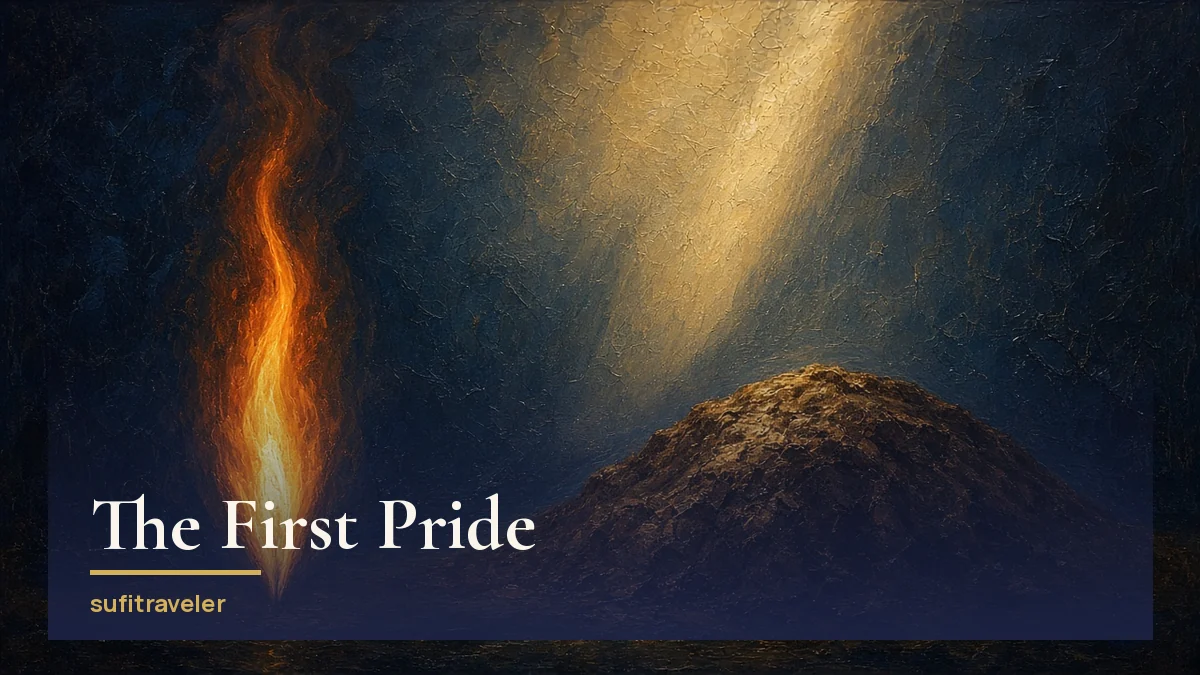
    God asks Iblis directly: “What prevented you from prostrating when I commanded you?” His answer is the root of the whole story: “I am better than him. You created me from fire and created him from clay” (7:12).

    Ibn Kathir points out that this was a false comparison. Clay, he writes, carries patience, steadiness and growth, while fire carries haste and burning.

    The angelsIblis
    First reactionAsked to understand, then said “we have no knowledge except what You have taught us”Refused
    Reason givenTrust in God’s knowledge“I am better than him”
    RootHumilityPride (kibr)
    OutcomeHonouredExpelled and cursed until the Day of Recompense
    Two responses to the same command

    Expelled, reprieved, and a vow

    God commands Iblis to leave: “Descend from it, for it is not for you to be arrogant therein. So get out; indeed, you are of the debased” (7:13). Iblis does not repent. Instead he asks for a delay “until the Day they are resurrected,” and it is granted until “the Day of the time well-known” (15:36-38).

    He then makes his vow. He will sit in wait on the straight path and come at people “from before them and from behind them and on their right and on their left” (7:16-17). In Surah Sad he swears, “By Your might, I will surely mislead them all, except, among them, Your chosen servants” (38:82-83).

    The promise of protection

    The story does not end with Iblis’s threat. It ends with God’s answer. “Indeed, My servants, no authority will you have over them, except those who follow you of the deviators” (15:42). Surah al-Kahf then asks the reader directly: “Will you take him and his descendants as allies other than Me while they are enemies to you?” (18:50).

    What we leave out

    Older books add names and details about Iblis drawn from Israiliyat (reports from earlier traditions) that cannot be confirmed. This series keeps to what the Qur’an says and what Ibn Kathir explains from it.

    Lessons for the traveller of the heart

    Pride was the first sin. It began quietly, with a comparison: “I am better than him.”

    Four reflections from the story

    1

    Notice comparison: pride often starts with measuring yourself against someone else.

    2

    Ask like the angels: questions asked to understand are not the same as refusal.

    3

    Say “we have no knowledge except what You have taught us”: humility about what we know keeps the heart soft.

    4

    Turn back quickly: Iblis was given time but did not repent; in the next story, Adam slips and does. For more, see our post on repentance (tawba).

    Tip

    Before reading the next story, try a short evening muhasaba: where today did I think “I am better than him”?

    FAQ

    Where is the story of Iblis and Adam in the Qur’an?

    The main passages are 2:30-34, 7:11-18, 15:28-44, 17:61-65, 18:50 and 38:71-85.

    Why did Iblis refuse to prostrate?

    Out of pride. He said, “I am better than him. You created me from fire and created him from clay” (7:12).

    Last checked: 23 October 2026 (Asia/Riyadh) against Qur’an 2:30-34, 7:11-18, 15:28-44, 17:61-65, 18:50 and 38:71-85 (Saheeh International translation) and Tafsir Ibn Kathir (Abridged) for 2:30, 2:34, 7:12 and 18:50. Educational reflection only, not a religious ruling.