Category: Qur’an Stories

  • The Two Sons of Adam: The Qur’an’s Story of Envy and the Crow

    The Two Sons of Adam: The Qur’an’s Story of Envy and the Crow

    The story of the two sons of Adam is short. It takes only six verses of Surah al-Ma’idah. Yet it holds the first killing in human history, the first grave and one of the most quoted principles in the Qur’an: that taking one innocent life is like killing all of humanity.

    This is day three of our Qur’an Stories series. The earlier stories showed pride in Iblis and repentance in Adam. Here the same struggle passes to the next generation. We read the verses on Quran.com in the Saheeh International translation and follow the explanation of Ibn Kathir. This is a reflection on meaning, not a ruling.

    Quick answer

    Short answer: Two sons of Adam each made an offering to God; “it was accepted from one of them but was not accepted from the other” (Qur’an 5:27). The rejected brother threatened to kill the other, who refused to fight back. He killed him anyway, then watched a crow scratch the ground and learned how to bury his brother. The passage ends with the principle that “whoever kills a soul… it is as if he had slain mankind entirely” (5:32).

    Where the story appears in the Qur’an

    Key takeaways

    • Passage: 5:27-32, in Surah al-Ma’idah, the only place the story is told.
    • Characters: “Adam’s two sons.” The Qur’an does not name them.
    • Turning point: one offering accepted, one not, and envy in response.
    • Principle: one life carries the weight of all humanity (5:32).

    What were their names?

    The names Habil and Qabil (Abel and Cain) are not in the Qur’an. They come from tafsir and from earlier traditions. Ibn Kathir uses them in his tafsir of 5:27, as many early commentators did. In this post we simply say “the two sons,” as the Qur’an does.

    “Recite to them the story, in truth”

    The passage opens with a command to the Prophet ﷺ: “And recite to them the story of Adam’s two sons, in truth” (5:27). Ibn Kathir explains that “in truth” means told clearly, without change, addition or confusion.

    Two offerings

    “They both made an offering [to Allāh], and it was accepted from one of them but was not accepted from the other” (5:27). The Qur’an does not say what the offerings were, how acceptance was shown, or what led to them.

    Commentators report a longer background involving a dispute over marriage. Ibn Kathir records these reports, but they rest on narrations from earlier traditions, and scholars differ on them. We leave them aside and keep to what the verses say.

    The verses do give one reason, in the words of the accepted brother: “Indeed, Allāh only accepts from the righteous [who fear Him].” Acceptance depends on the heart of the giver, not on the size of the gift.

    “I shall not raise my hand”

    The rejected brother answered with a threat: “I will surely kill you.” His brother’s reply is one of the most striking in the Qur’an: “If you should raise your hand toward me to kill me – I shall not raise my hand toward you to kill you. Indeed, I fear Allāh, Lord of the worlds” (5:28).

    He added a warning: “I want you to obtain [thereby] my sin and your sin so you will be among the companions of the Fire. And that is the recompense of wrongdoers” (5:29).

    The accepted brotherThe rejected brother
    Response to the outcomePointed to taqwa: God accepts from the righteousEnvy and a threat
    Response to the threat“I shall not raise my hand”Let his soul make the murder seem acceptable
    What he fearedGod, Lord of the worldsLosing to his brother
    EndSpoke the truth to the last“Became among the losers” and “of the regretful”
    Two brothers, two hearts

    “His soul permitted to him”

    “And his soul permitted to him the murder of his brother, so he killed him and became among the losers” (5:30). The wording is precise. It was his own soul that made the crime seem acceptable to him.

    The crow

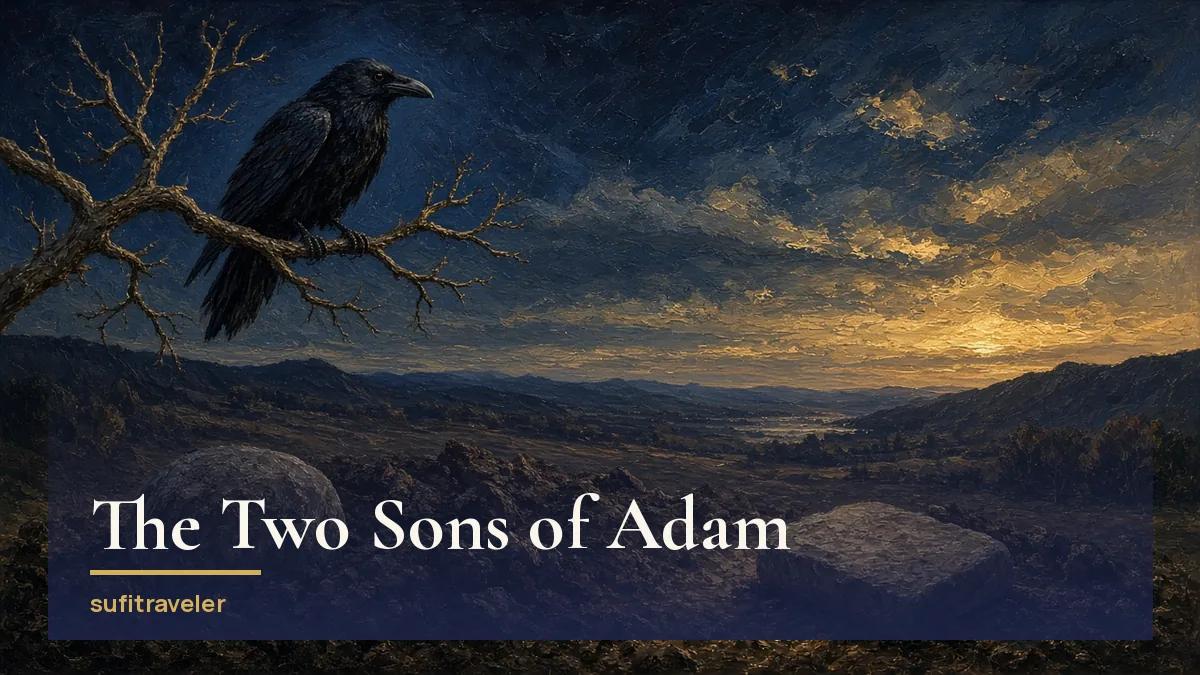
    “Then Allāh sent a crow searching [i.e., scratching] in the ground to show him how to hide the disgrace of his brother” (5:31).

    His words afterwards are full of bitterness: “O woe to me! Have I failed to be like this crow and hide the disgrace [i.e., body] of my brother?” The verse ends, “And he became of the regretful.” The Qur’an records his regret, but it does not describe him turning to God, which sets this regret apart from Adam’s repentance in the story before.

    What we leave out

    Many details in older books, such as how long he carried the body, where it happened, or what punishment followed in this life, come from Israiliyat (reports from earlier traditions). They cannot be confirmed, so this series does not present them as fact.

    One life, all of humanity

    The story closes with a principle: “Because of that, We decreed upon the Children of Israel that whoever kills a soul unless for a soul or for corruption [done] in the land – it is as if he had slain mankind entirely. And whoever saves one – it is as if he had saved mankind entirely” (5:32).

    Ibn Kathir explains in his tafsir of 5:32 that this is because there is no difference between one life and another. Whoever protects a single innocent life, and holds it sacred, has in effect kept all people safe from himself.

    Lessons for the traveller of the heart

    Four reflections from the story

    1

    Look at the heart, not the gift: “Allāh only accepts from the righteous.”

    2

    Watch envy early: the killing began as resentment of someone else’s blessing.

    3

    Refuse to answer wrong with wrong: the accepted brother held back his hand out of fear of God.

    4

    Know regret from repentance: sorrow for the consequences is not the same as turning back to God.

    Tip

    Envy is cured by good character. When you notice it, pray for the person you envy. See our post on good character (husn al-khuluq), and try a short evening muhasaba.

    FAQ

    Where is the story of the two sons of Adam in the Qur’an?

    In Surah al-Ma’idah, 5:27-32.

    Does the Qur’an name the two sons of Adam?

    No. The names Habil and Qabil come from tafsir and earlier traditions, not from the Qur’an.

    Last checked: 23 October 2026 (Asia/Riyadh) against Qur’an 5:27-32 (Saheeh International translation) and Tafsir Ibn Kathir (Abridged) for 5:27 and 5:32. Educational reflection only, not a religious ruling.

  • Adam and the Forbidden Tree: The Qur’an’s First Story of Repentance

    Adam and the Forbidden Tree: The Qur’an’s First Story of Repentance

    The story of Prophet Adam and the forbidden tree is the first account in the Qur’an of a human being who slips and then turns back to God. It is told in three surahs: al-Baqarah, al-A’raf and Ta-Ha.

    This is day two of our Qur’an Stories series. Day one told how Iblis refused to bow to Adam out of pride. We read the verses on Quran.com in the Saheeh International translation and follow the explanation of Ibn Kathir. This is a reflection on meaning, not a ruling.

    Quick answer

    Short answer: God told Adam, “dwell, you and your wife, in Paradise and eat therefrom in [ease and] abundance from wherever you will. But do not approach this tree” (Qur’an 2:35). Satan whispered to them and swore he was a sincere adviser. They ate, realised their mistake and said, “Our Lord, we have wronged ourselves” (7:23). God accepted Adam’s repentance and sent them down to earth with a promise of guidance.

    Where the story appears in the Qur’an

    Key takeaways

    • The garden, the slip and the words of repentance: 2:35-39, in Surah al-Baqarah.
    • Satan’s whisper, his oath and Adam’s prayer: 7:19-25, in Surah al-A’raf.
    • The forgotten promise and “the tree of eternity”: 20:115-123, in Surah Ta-Ha.
    • Lesson: a slip followed by sincere repentance becomes a return to God.

    Life in the garden

    After the angels’ prostration, God gave Adam and his wife a home of ease. In Surah Ta-Ha He describes it: “Indeed, it is [promised] for you not to be hungry therein or be unclothed. And indeed, you will not be thirsty therein or be hot from the sun” (20:118-119).

    Ibn Kathir, in his tafsir of 20:115, notes that these pairs cover inner and outer hardship alike.

    There was only one limit. “Do not approach this tree, lest you be among the wrongdoers” (7:19). Ibn Kathir describes this command as a test.

    Which tree was it?

    The Qur’an does not name the tree, and neither does the authentic Sunnah. Older commentators suggested grapes, wheat, figs and other plants, so scholars differ. Ibn Kathir, in his tafsir of 2:35, agrees with Ibn Jarir al-Tabari that the correct view is that we do not know. The name of Adam’s wife, Hawwa’, likewise comes from hadith and tafsir, not the Qur’an.

    The whisper

    Satan did not attack in the open. “Satan whispered to them,” the Qur’an says, and he offered them something that sounded good: “Your Lord did not forbid you this tree except that you become angels or become of the immortal” (7:20). In Ta-Ha he calls it “the tree of eternity and possession that will not deteriorate” (20:120).

    Then he added an oath: “Indeed, I am to you from among the sincere advisors” (7:21). Ibn Kathir comments in his tafsir of 7:20 that a believer can sometimes be taken in by deceit, especially when it is sworn in God’s name.

    What God saidWhat Satan said
    About the tree“Do not approach this tree”It brings eternity and a kingdom that never fades
    About Satan“Indeed this is an enemy to you”“I am to you from among the sincere advisors”
    God’s word and Satan’s whisper

    The slip

    “So he made them fall, through deception” (7:22). As soon as they tasted the tree, “their private parts became apparent to them, and they began to fasten together over themselves from the leaves of Paradise.”

    Surah Ta-Ha names the slip directly: “And Adam disobeyed his Lord and erred” (20:121). It also gives its cause: “We had already taken a promise from Adam before, but he forgot; and We found not in him determination” (20:115).

    The words of repentance

    Here is the point where Adam’s story parts from the story of Iblis. Iblis argued and asked for a delay. Adam and his wife admitted the wrong at once: “Our Lord, we have wronged ourselves, and if You do not forgive us and have mercy upon us, we will surely be among the losers” (7:23).

    Surah al-Baqarah says, “Then Adam received from his Lord [some] words, and He accepted his repentance. Indeed, it is He who is the Accepting of Repentance, the Merciful” (2:37). In his tafsir of 2:37, Ibn Kathir reports that many early scholars, among them Mujahid, Sa’id ibn Jubayr and Qatadah, said these “words” were the prayer of 7:23. Other reports give different wording, so scholars differ on the exact words, but they agree that God taught them and then accepted them.

    How the return unfolds in the verses

    1

    Admit: “we have wronged ourselves” (7:23).

    2

    Ask: for forgiveness and mercy, naming the loss without it.

    3

    Receive: God gives the words and accepts the repentance (2:37).

    4

    Be chosen: “Then his Lord chose him and turned to him in forgiveness and guided [him]” (20:122).

    Down to earth, with guidance

    The descent to earth came with a promise. “Go down from it, all of you. And when guidance comes to you from Me, whoever follows My guidance – there will be no fear concerning them, nor will they grieve” (2:38). Earth would be “a place of settlement and provision for a time” (2:36): “Therein you will live, and therein you will die, and from it you will be brought forth” (7:25).

    What we leave out

    Some older books add details from Israiliyat (reports from earlier traditions), such as how Satan entered the garden or where on earth Adam and his wife landed. These cannot be confirmed, so this series keeps to what the Qur’an says and what Ibn Kathir explains from it.

    Lessons for the traveller of the heart

    Adam’s story is the hopeful twin of the story of Iblis. Both disobeyed a command. One defended himself; the other said “we have wronged ourselves.”

    Tip

    Tonight, try the prayer of 7:23 after a short muhasaba. For how the Sufi masters describe the stages of turning back, see Qushayri on repentance (tawba).

    FAQ

    Where is the story of Adam and the forbidden tree in the Qur’an?

    The main passages are 2:35-39, 7:19-25 and 20:115-123.

    What did Adam say when he repented?

    The Qur’an gives the prayer: “Our Lord, we have wronged ourselves, and if You do not forgive us and have mercy upon us, we will surely be among the losers” (7:23).

    Last checked: 23 October 2026 (Asia/Riyadh) against Qur’an 2:35-39, 7:19-25 and 20:115-123 (Saheeh International translation) and Tafsir Ibn Kathir (Abridged) for 2:35, 2:37, 7:20 and 20:115. Educational reflection only, not a religious ruling.