surah al-araf

  • Prophet Salih and the She-Camel: Why Was It a Test?

    Prophet Salih and the She-Camel: Why Was It a Test?

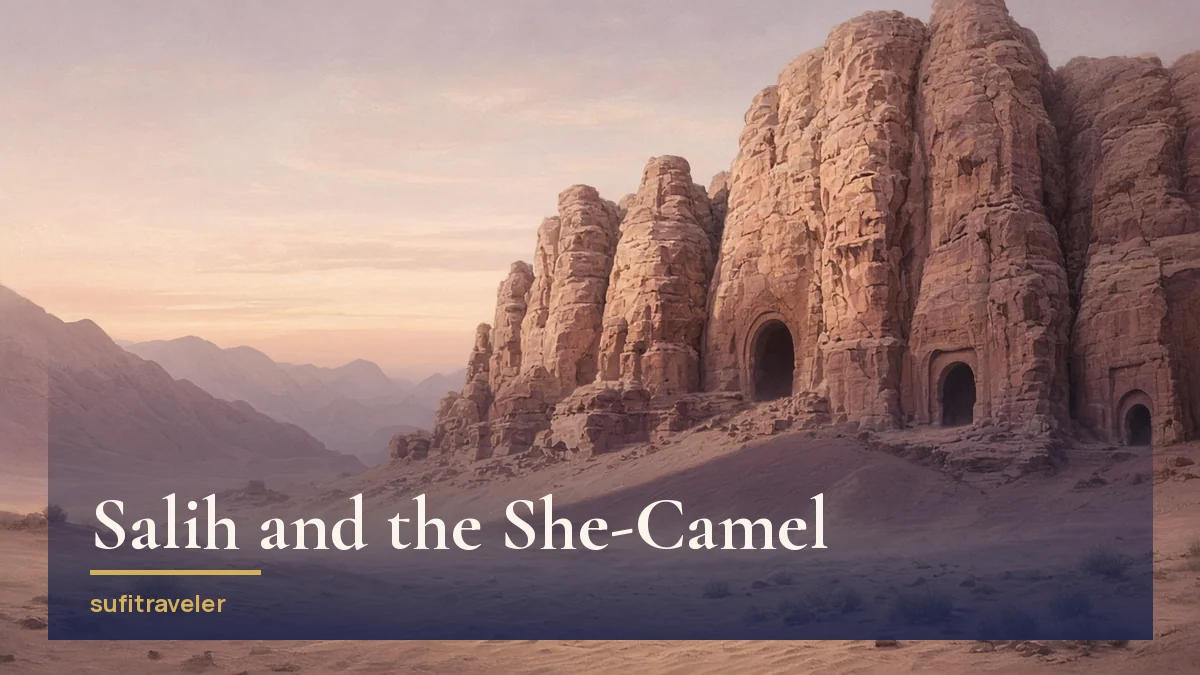
    After ‘Ad came another strong nation: Thamud. They carved homes into mountains and lived among gardens and springs. God sent them their brother Salih, peace be upon him, and gave them a sign they could see with their own eyes: a she-camel.

    This is day nine of our Qur’an Stories series. Earlier we followed Prophet Hud and the people of ‘Ad. Here we ask a simple question: why was the she-camel a test? The English meanings below are our own wording. It is a reflection on meaning, not a ruling.

    Quick answer

    Short answer: Salih called Thamud to worship God alone (11:61). They asked for a sign, and God sent a she-camel with a share of water on fixed days (26:154-155). They were told not to harm her (7:73). The camel was a clear sign, and signs are sent as a warning (17:59).

    Where the story appears

    Where Salih appears in the Qur’an

    • Surah al-A’raf: Salih’s call and the sign of the she-camel (7:73-79).
    • Surah Hud: his hopes for his people and their doubt (11:61-68).
    • Surah ash-Shu’ara: their comforts, their demand for a sign and the shared water (26:141-159).
    • Surah al-Isra: the she-camel named as a visible sign (17:59).

    Who were Thamud?

    The Qur’an tells us that God made Thamud successors after ‘Ad and settled them in the land. They built palaces on its plains and carved houses out of the mountains (7:74). They had gardens, springs, crops and palms with soft, tender clusters (26:146-148).

    Salih reminded them that it was God who brought them out of the earth and settled them in it (11:61). Their skill was real, but it was a gift, not their own making alone.

    What did Salih ask of them?

    His message was the same as Hud’s before him: worship God, you have no god but Him. Ask His forgiveness and turn back to Him, for He is near and answers (11:61).

    Like every prophet, he asked no payment. In meaning (our words): I ask you for no reward for this; my reward is only with the Lord of the worlds (26:145). He also warned them not to obey the extravagant, who spread corruption and never set things right (26:151-152).

    Why did his people doubt him?

    Their answer is striking. They said, in meaning (our words): Salih, you were someone we looked to before this (11:62). They had placed their hopes in him. Now he was asking them to leave what their fathers worshipped, and they said they were in deep doubt about his call.

    They also called him bewitched and said he was only a man like them (26:153-154). Then they asked for proof: bring us a sign, if you are truthful.

    Why a she-camel?

    God answered their request. Salih said, in meaning (our words): this is the she-camel of God, a sign for you. Leave her to graze on God’s earth and do not touch her with harm, or a painful punishment will seize you (7:73, 11:64).

    She came with a rule. She would have her share of water, and they would have theirs, each on a known day (26:155). The Qur’an calls her a clear sign, and says signs are sent only to warn (17:59).

    They asked forThe test asked them to
    A visible sign (26:154)Believe what they had seen
    Proof of Salih’s truthLeave her free to graze (7:73)
    Something to settle their doubt (11:62)Share their water on fixed days (26:155)
    What they asked for and what the test asked of them

    What made it a test?

    Our reflection: the sign did not ask them to do anything hard. It asked them to hold back. Leave her alone. Share the water. Sometimes the real test is not doing more, but making room for what God has placed among us.

    The Qur’an also shows a split among the people. The proud chiefs asked the weaker believers whether they truly thought Salih was sent by his Lord. The believers said yes, they believed in his message. The proud said they rejected it (7:75-76).

    Tip

    A small habit from this story: when you ask God for a sign or an answer, be ready to act on it when it comes.

    How did it end?

    In one line: they hamstrung the camel and defied God’s command (7:77), and God saved Salih and the believers by His mercy (11:66). We tell what happened to Thamud in full in our next story.

    Lessons for the heart

    • Gifts point to the Giver. Homes, gardens and skill all came from God.
    • Signs bring responsibility. Asking for proof means being ready to follow it.
    • Restraint can be worship. The command was simply: do not harm her.
    • God is near. Salih told them, in meaning (our words): my Lord is near and answers (11:61).

    Sources

    Verse meanings are our own wording, cross-checked for sense against standard translations: 7:73-79, 11:61-68, 26:141-159 and 17:59.
  • Only Allah Knows When the Hour Comes: Signs of the Hour, Part 1

    Only Allah Knows When the Hour Comes: Signs of the Hour, Part 1

    People have always asked when the world will end. Some grow anxious, and others try to work out a date. Islam answers the question gently and firmly: the time of the Hour is known to Allah alone.

    This is the first post in our Signs of the Hour series. It sets the rule the whole series follows. We will look at what the Qur’an and sound hadith say, calmly and with care, and we will never set dates or tie any sign to current events. For more sound narrations, see our hadith library.

    Quick answer

    Short answer: The Qur’an says the knowledge of the Hour is with Allah alone, and it will come suddenly (7:187). When the Prophet ﷺ was asked about the Hour, he said the one being asked knew no more about it than the one asking (Sahih Muslim 8, Sahih). So no one can give its date.

    What the Qur’an says

    In Surah al-A’raf, Allah tells the Prophet ﷺ how to answer those who ask about the Hour.

    Quran 7:187

    • Arabic: يَسْأَلُونَكَ عَنِ السَّاعَةِ أَيَّانَ مُرْسَاهَا ۖ قُلْ إِنَّمَا عِلْمُهَا عِنْدَ رَبِّي ۖ لَا يُجَلِّيهَا لِوَقْتِهَا إِلَّا هُوَ ۚ ثَقُلَتْ فِي السَّمَاوَاتِ وَالْأَرْضِ ۚ لَا تَأْتِيكُمْ إِلَّا بَغْتَةً ۗ يَسْأَلُونَكَ كَأَنَّكَ حَفِيٌّ عَنْهَا ۖ قُلْ إِنَّمَا عِلْمُهَا عِنْدَ اللَّهِ وَلَٰكِنَّ أَكْثَرَ النَّاسِ لَا يَعْلَمُونَ
    • Meaning (our own words): They ask you about the Hour and when it will take place. Say: its knowledge is with my Lord alone, and none but He will make it appear at its time. It is weighty in the heavens and the earth, and it will come upon you only suddenly. They ask you as if you knew all about it. Say: its knowledge is with Allah alone, but most people do not know.
    • Reference: Surah al-A’raf, 7:187 (Quran.com).

    Three points stand out in this verse.

    First, the answer is given twice. Both times the Prophet ﷺ is told to say that the knowledge belongs to Allah. The repetition leaves no room for guessing.

    Second, the Hour is described as weighty in the heavens and the earth. It is a serious matter, not a puzzle to solve or a game of predictions.

    Third, it comes suddenly. If it comes without warning, no calculation can fix its day.

    What the Prophet ﷺ said

    The best-known hadith on this is part of the long narration known as the hadith of Jibril, reported by Umar ibn al-Khattab and recorded by Imam Muslim.

    The hadith

    • Content (our own words): When the Prophet ﷺ was asked about the Hour by Jibril, who came in the form of a man, he answered that the one being asked knew no more about it than the one asking.
    • Reference: Sahih Muslim, Book of Faith, hadith 8 (sunnah.com 8a), narrated by Umar ibn al-Khattab.
    • Grade: Sahih (by inclusion in Sahih Muslim).

    This is a striking answer. When asked, he answered that the one asked knew no more about it than the one asking, so he gave no time. The Messenger of Allah ﷺ himself gave no date, so no one after him can.

    Why this comes first

    Every later post in this series rests on these two texts. The signs that the Prophet ﷺ described are real, and we will study them one by one. But signs are not a timetable. They remind us that the Hour is true; they do not tell us its date.

    So this series keeps some simple rules:

    • No dates and no countdowns. Any claim to know the year or the day goes against the verse and the hadith above.
    • No tying signs to the news. We will not name countries, leaders, wars or disasters as the fulfilment of any sign.
    • Sound sources only. We use the Qur’an and hadith from Sahih al-Bukhari and Sahih Muslim only, each with its collection and number.
    • Calm, not fear. The aim is reflection and preparation, not alarm.

    Warning

    A note on predictions. You may come across posts, videos or messages that claim to know when the end of times will come. The Qur’an (7:187) and the hadith in Sahih Muslim (8) are clear that this knowledge is with Allah alone. Treat any such date claim with caution, and do not share it.

    Lessons for the heart

    • Humility. Not knowing is part of being a servant. Even the Prophet ﷺ answered that the one asked knew no more about it than the one asking, and gave no time.
    • Peace instead of anxiety. We are not asked to calculate the Hour. That frees the heart from worry over dates.
    • Readiness. Because the Hour comes suddenly, the wise response is to live well today: to pray, to repent and to treat people kindly.
    • Trust. What Allah has kept hidden, He has kept hidden for a reason. Leaving it with Him is part of faith.

    What comes next

    In the next post we look at how the coming of the Prophet ﷺ is itself counted among the signs of the Hour. Until then, you can read more reflections in our teachings section.

    Sources

    • Qur’an 7:187, Quran.com. Arabic as checked by our authenticity lead against the Tanzil text (api.alquran.cloud, quran-simple). The meaning is our own wording.
    • Sahih Muslim, Book of Faith, hadith 8, the hadith of Jibril, narrated by Umar ibn al-Khattab, graded Sahih (by inclusion), sunnah.com 8a. The content is described in our own words.

    Part of the Signs of the Hour series: back to all parts

    ← Previous: this is Part 1 · Next: Part 2 coming soon (see all parts) →

  • Adam and the Forbidden Tree: The Qur’an’s First Story of Repentance

    Adam and the Forbidden Tree: The Qur’an’s First Story of Repentance

    The story of Prophet Adam and the forbidden tree is the first account in the Qur’an of a human being who slips and then turns back to God. It is told in three surahs: al-Baqarah, al-A’raf and Ta-Ha.

    This is day two of our Qur’an Stories series. Day one told how Iblis refused to bow to Adam out of pride. We read the verses on Quran.com in the Saheeh International translation and follow the explanation of Ibn Kathir. This is a reflection on meaning, not a ruling.

    Quick answer

    Short answer: God told Adam, “dwell, you and your wife, in Paradise and eat therefrom in [ease and] abundance from wherever you will. But do not approach this tree” (Qur’an 2:35). Satan whispered to them and swore he was a sincere adviser. They ate, realised their mistake and said, “Our Lord, we have wronged ourselves” (7:23). God accepted Adam’s repentance and sent them down to earth with a promise of guidance.

    Where the story appears in the Qur’an

    Key takeaways

    • The garden, the slip and the words of repentance: 2:35-39, in Surah al-Baqarah.
    • Satan’s whisper, his oath and Adam’s prayer: 7:19-25, in Surah al-A’raf.
    • The forgotten promise and “the tree of eternity”: 20:115-123, in Surah Ta-Ha.
    • Lesson: a slip followed by sincere repentance becomes a return to God.

    Life in the garden

    After the angels’ prostration, God gave Adam and his wife a home of ease. In Surah Ta-Ha He describes it: “Indeed, it is [promised] for you not to be hungry therein or be unclothed. And indeed, you will not be thirsty therein or be hot from the sun” (20:118-119).

    Ibn Kathir, in his tafsir of 20:115, notes that these pairs cover inner and outer hardship alike.

    There was only one limit. “Do not approach this tree, lest you be among the wrongdoers” (7:19). Ibn Kathir describes this command as a test.

    Which tree was it?

    The Qur’an does not name the tree, and neither does the authentic Sunnah. Older commentators suggested grapes, wheat, figs and other plants, so scholars differ. Ibn Kathir, in his tafsir of 2:35, agrees with Ibn Jarir al-Tabari that the correct view is that we do not know. The name of Adam’s wife, Hawwa’, likewise comes from hadith and tafsir, not the Qur’an.

    The whisper

    Satan did not attack in the open. “Satan whispered to them,” the Qur’an says, and he offered them something that sounded good: “Your Lord did not forbid you this tree except that you become angels or become of the immortal” (7:20). In Ta-Ha he calls it “the tree of eternity and possession that will not deteriorate” (20:120).

    Then he added an oath: “Indeed, I am to you from among the sincere advisors” (7:21). Ibn Kathir comments in his tafsir of 7:20 that a believer can sometimes be taken in by deceit, especially when it is sworn in God’s name.

    What God saidWhat Satan said
    About the tree“Do not approach this tree”It brings eternity and a kingdom that never fades
    About Satan“Indeed this is an enemy to you”“I am to you from among the sincere advisors”
    God’s word and Satan’s whisper

    The slip

    “So he made them fall, through deception” (7:22). As soon as they tasted the tree, “their private parts became apparent to them, and they began to fasten together over themselves from the leaves of Paradise.”

    Surah Ta-Ha names the slip directly: “And Adam disobeyed his Lord and erred” (20:121). It also gives its cause: “We had already taken a promise from Adam before, but he forgot; and We found not in him determination” (20:115).

    The words of repentance

    Here is the point where Adam’s story parts from the story of Iblis. Iblis argued and asked for a delay. Adam and his wife admitted the wrong at once: “Our Lord, we have wronged ourselves, and if You do not forgive us and have mercy upon us, we will surely be among the losers” (7:23).

    Surah al-Baqarah says, “Then Adam received from his Lord [some] words, and He accepted his repentance. Indeed, it is He who is the Accepting of Repentance, the Merciful” (2:37). In his tafsir of 2:37, Ibn Kathir reports that many early scholars, among them Mujahid, Sa’id ibn Jubayr and Qatadah, said these “words” were the prayer of 7:23. Other reports give different wording, so scholars differ on the exact words, but they agree that God taught them and then accepted them.

    How the return unfolds in the verses

    1

    Admit: “we have wronged ourselves” (7:23).

    2

    Ask: for forgiveness and mercy, naming the loss without it.

    3

    Receive: God gives the words and accepts the repentance (2:37).

    4

    Be chosen: “Then his Lord chose him and turned to him in forgiveness and guided [him]” (20:122).

    Down to earth, with guidance

    The descent to earth came with a promise. “Go down from it, all of you. And when guidance comes to you from Me, whoever follows My guidance – there will be no fear concerning them, nor will they grieve” (2:38). Earth would be “a place of settlement and provision for a time” (2:36): “Therein you will live, and therein you will die, and from it you will be brought forth” (7:25).

    What we leave out

    Some older books add details from Israiliyat (reports from earlier traditions), such as how Satan entered the garden or where on earth Adam and his wife landed. These cannot be confirmed, so this series keeps to what the Qur’an says and what Ibn Kathir explains from it.

    Lessons for the traveller of the heart

    Adam’s story is the hopeful twin of the story of Iblis. Both disobeyed a command. One defended himself; the other said “we have wronged ourselves.”

    Tip

    Tonight, try the prayer of 7:23 after a short muhasaba. For how the Sufi masters describe the stages of turning back, see Qushayri on repentance (tawba).

    FAQ

    Where is the story of Adam and the forbidden tree in the Qur’an?

    The main passages are 2:35-39, 7:19-25 and 20:115-123.

    What did Adam say when he repented?

    The Qur’an gives the prayer: “Our Lord, we have wronged ourselves, and if You do not forgive us and have mercy upon us, we will surely be among the losers” (7:23).

    Last checked: 23 October 2026 (Asia/Riyadh) against Qur’an 2:35-39, 7:19-25 and 20:115-123 (Saheeh International translation) and Tafsir Ibn Kathir (Abridged) for 2:35, 2:37, 7:20 and 20:115. Educational reflection only, not a religious ruling.