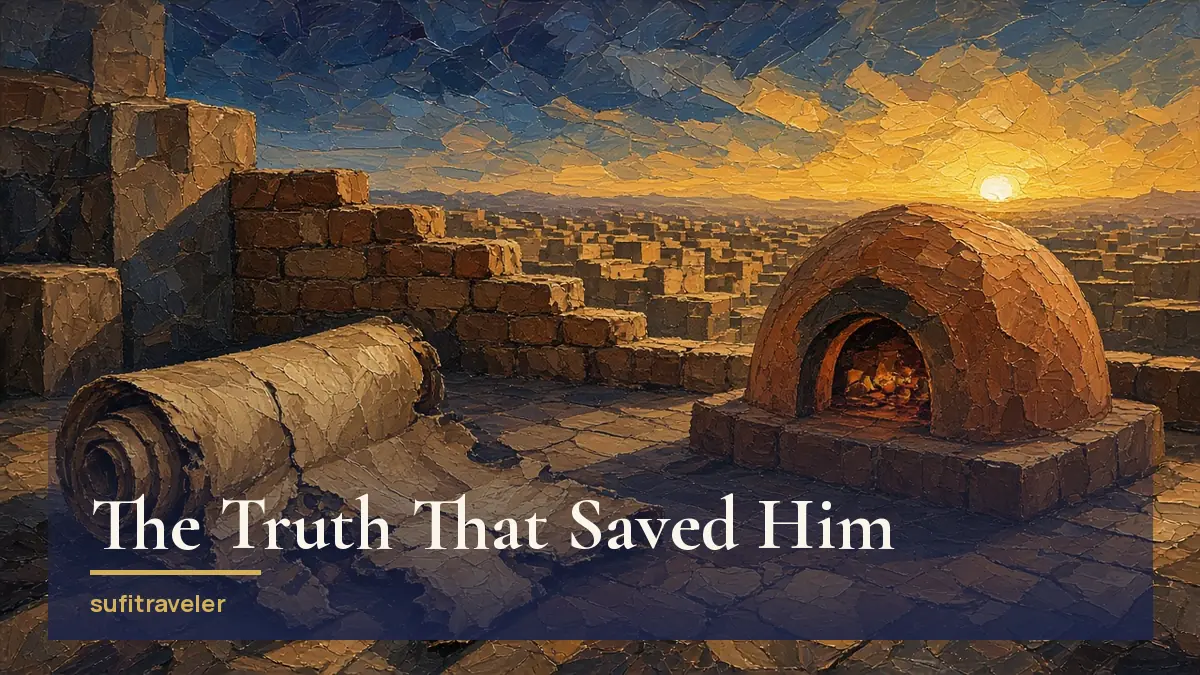
Some of the strongest teachings on truthfulness are told as stories. The story of Ka’b ibn Malik, a Companion of the Prophet (peace be upon him) from Madinah, is one of the longest first-person narrations in the hadith collections. He tells it himself: the worst failure of his life, and how one truthful answer turned it into his greatest blessing.
It complements our introduction to sidq (truthfulness) in classical Sufi teaching, which explains the principle; here we see it lived.
Quick answer
Short answer: Ka’b ibn Malik stayed behind from the expedition of Tabuk without any excuse. When the Prophet (peace be upon him) returned, more than eighty men offered false excuses, but Ka’b told the plain truth. He and two others were left waiting for fifty nights, shunned by the community, until Allah revealed that their repentance was accepted (Qur’an 9:117-119). The narration is in Sahih al-Bukhari 4418 and Sahih Muslim 2769.
The sources
About this narration
- Narrator: Ka’b ibn Malik, through his son ‘Abdullah.
- Collections: Sahih al-Bukhari 4418 and Sahih Muslim 2769, both from the two most authoritative hadith collections.
- Qur’an: the verses about the three who were left behind are in Surat al-Tawbah, 9:117-119.
- Grading: sahih; both collections are accepted as authentic by Sunni scholars.
The retelling below is in our own words; the few direct quotes are marked and attributed.
Putting it off
Ka’b opens by admitting that he had no excuse. At the time of Tabuk he was better off than ever, owning two riding camels. The journey ahead was long and the heat was fierce, so the Prophet (peace be upon him) told everyone plainly where they were going, so that they could get ready.
Ka’b fully intended to go. Day after day he set out to prepare and came home with nothing done, reassuring himself: “I can do that” (Sahih al-Bukhari 4418, sunnah.com translation). The army marched out, he kept putting it off, and in the end the chance was gone.
The moment of choice
When he heard the Prophet (peace be upon him) was on his way back, Ka’b started rehearsing excuses. But as the Prophet came closer, the excuses fell away. He realised a lie would never get him out of this, and he made up his mind to tell the truth.
Over eighty men came with excuses and oaths, which were accepted at face value.
Then it was Ka’b’s turn. Asked why he had stayed behind, he admitted that he was skilled with words and could have talked his way out of trouble with anyone else. But a lie told now, he said, would be exposed by Allah before long, while the truth, however unwelcome today, left room to hope for forgiveness. Then he said simply: “Really, by Allah, there was no excuse for me” (Sahih al-Bukhari 4418, sunnah.com translation).
The Prophet (peace be upon him) replied: “As regards this man, he has surely told the truth. So get up till Allah decides your case” (Sahih al-Bukhari 4418, sunnah.com translation).
Pressure to take the easy way
That was not the end of the test. Men from his own clan went after him and scolded him: why hadn’t he offered an excuse like everyone else and let the Prophet’s prayer for forgiveness cover him?
What kept him firm was hearing that two others had answered the same way: Murara ibn al-Rabi’ and Hilal ibn Umayya, both veterans of Badr. Their example kept him from changing his answer.
Fifty nights
The community was told not to speak to the three men. Ka’b still went to the prayers and the market, though no one spoke to him.
In the middle of this, a letter came from the king of Ghassan, offering him a warm welcome if he would come over. Ka’b’s reaction was: “This is also a sort of a test” (Sahih al-Bukhari 4418, sunnah.com translation). He put the letter into an oven and burned it.
Relief at dawn
On the fiftieth morning, Ka’b prayed Fajr on a rooftop, feeling that the whole world had closed in around him. Then a man shouted from the hill of Sala’, telling him to rejoice. Ka’b fell down in prostration.
Allah had accepted their repentance. In our own paraphrase, Qur’an 9:118 speaks of the three who were left behind: the earth, wide as it is, felt tight to them and so did their own souls, until they understood that the only refuge from Allah is with Allah, and He turned to them in mercy. The next verse tells believers to be mindful of Allah and stay with the truthful (Qur’an 9:117-119).
When Ka’b reached the Prophet (peace be upon him), he was told that this was the best day he had known since the day he was born.
What Ka’b took from it
Ka’b’s own conclusion is the heart of the story: “Allah has saved me for telling the truth; so it is a part of my repentance not to tell but the truth as long as I am alive” (Sahih al-Bukhari 4418, sunnah.com translation).
He set his own case beside that of the men who had sworn false oaths, whom the Qur’an describes in 9:95-96. Other than being guided to Islam, he said, no blessing in his life was greater than not having lied that day.
Lessons for everyday life
Living the lesson
1
Watch the small delays. Ka’b’s failure began with putting things off until tomorrow. Notice where you are postponing what you know you should do.
2
Own it plainly. When you have fallen short, the first step is an honest account, without polishing.
3
Accept that truth may cost something now. Ka’b chose short-term difficulty over a lie that would have followed him.
4
Stay with good company. Find people whose example holds you steady when others push you towards the easy way.
These lessons fit closely with the classical teaching on truthfulness, especially what al-Ghazali calls truth in resolve and in fulfilling it, and with muhasaba, the practice of self-accounting.
Study with a teacher
This post retells an authentic narration and draws general lessons. It is not a ruling on any question of law. For detailed explanation of the narration and its rulings, study with a qualified teacher.
FAQ
Where is the story of Ka’b ibn Malik found?
In Sahih al-Bukhari 4418 and Sahih Muslim 2769, narrated by Ka’b himself through his son ‘Abdullah.
Last checked: 14 October 2026 against the Sahih al-Bukhari 4418, Sahih Muslim 2769 and Qur’an references linked above. Educational retelling only, not a religious ruling.
Leave a Reply