By Dr. Malik Sherjeel Awan, PsyD
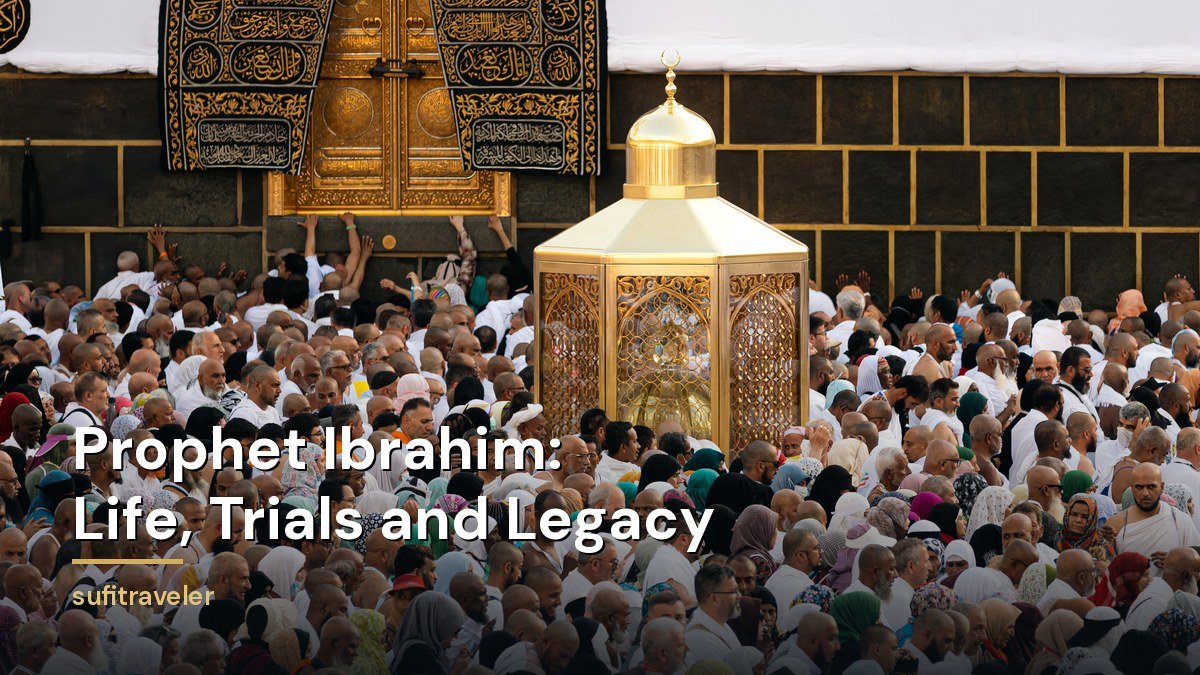
Every year, millions of pilgrims walk in the footsteps of one man and his family. They pray near the station of Ibrahim, walk between Safa and Marwah as Hajar did, and drink from the well that sprang up for her son. Prophet Ibrahim (Abraham), peace be upon him, is at the heart of Hajj, and at the heart of what it means to trust Allah.
The Qur’an calls him “a man of truth and a prophet” (19:41), “a [comprehensive] leader, devoutly obedient to Allah, inclining toward truth” (16:120), and says “Allah took Abraham as an intimate friend” (4:125). It holds him up as “an excellent pattern” for believers (60:4).
This post follows his life through the Qur’an, with authentic hadith where they add detail.
1. A young man searching for truth
The Qur’an describes Ibrahim questioning the worship of his people. He asks his father Azar, “Do you take idols as deities? Indeed, I see you and your people to be in manifest error” (6:74).
Then comes a well-known passage. Ibrahim looks at a star, then the moon, then the sun, and each time it sets, he turns away: “I like not those that set” (6:76). He concludes by turning his face to the Creator of the heavens and the earth (6:74–79). Many commentators read this as Ibrahim reasoning with his people, leading them step by step to see that what disappears cannot be God.
Gentle words with his father
Ibrahim’s disagreement with his father is firm but tender. In Surah Maryam he speaks to him with respect, calling him “O my father”, and when rejected, answers, “Peace will be upon you” (19:41–48). Even in the deepest disagreement, his manners stay good.
2. The idols and the fire
Ibrahim broke the idols of his people and left the largest standing, to make them think (21:51–67). We tell this part in detail in Why did Ibrahim break the idols?.
His people decided to burn him. The Qur’an records Allah’s command: “O fire, be coolness and safety upon Abraham” (21:69).
3. “So that my heart may be satisfied”
One of the most human moments in his story: Ibrahim asks Allah to show him how He gives life to the dead. Allah asks, “Have you not believed?” Ibrahim replies, “Yes, but [I ask] only that my heart may be satisfied” (2:260).
As a psychologist, I find this verse very comforting. A prophet of Allah, sure of his faith, still asked for his heart to be put at rest. Asking questions and wanting deeper certainty sit comfortably alongside faith.
4. Hajar, Ismail and the barren valley
Ibrahim settled his wife Hajar and their infant son Ismail in the valley of Makkah, then uncultivated, beside the Sacred House. He prayed: “Our Lord, I have settled some of my descendants in an uncultivated valley near Your sacred House… that they may establish prayer. So make hearts among the people incline toward them and provide for them from the fruits” (14:37).
Sahih al-Bukhari 3364 records Hajar’s question, “Has Allah ordered you to do so?” When he said yes, she replied, “Then He will not neglect us.” What followed (her search between Safa and Marwah, and the spring of Zamzam) is told in our next story, Hajar and the Well of Zamzam.
5. The great test: the sacrifice
Ibrahim had asked Allah for a righteous child (37:100). When the boy was old enough to work alongside him, Ibrahim told him of a dream: “O my son, indeed I have seen in a dream that I [must] sacrifice you, so see what you think.” The son replied, “O my father, do as you are commanded. You will find me, if Allah wills, of the steadfast” (37:102).
When both had submitted, Allah called to Ibrahim that he had fulfilled the vision, and “We ransomed him with a great sacrifice” (37:107). The Qur’an then gives Ibrahim the good news of Ishaq (37:112). Most scholars identify the son of the sacrifice as Ismail, partly because Ishaq’s birth is announced after the story. Some held a different view, which classical tafsir discusses.
Muslims remember this every Eid al-Adha through the sacrifice (udhiyah). Rulings on it differ between schools, so consult a scholar.
6. Building the Kaaba
Years later, Ibrahim returned and, with Ismail, raised the foundations of the House: “And [mention] when Abraham was raising the foundations of the House and [with him] Ishmael, [saying], ‘Our Lord, accept [this] from us. Indeed, You are the Hearing, the Knowing’” (2:127).
Sahih al-Bukhari 3364 adds touching detail: Ismail brought the stones while Ibrahim built, and when the walls grew high, Ismail brought a stone for his father to stand on. Both kept repeating that same prayer as they worked.
Allah designated the site of the House for Ibrahim and commanded him to purify it for those who perform tawaf, stand, bow and prostrate (22:26).
7. The call to Hajj
Then came the command: “And proclaim to the people the Hajj; they will come to you on foot and on every lean camel; they will come from every distant pass” (22:27). Every pilgrim who answers that call today is answering Ibrahim’s proclamation.
If you’re preparing for Hajj, see How to perform Hajj on our sister site, madinamakkah.com.
8. A father’s prayers
Ibrahim’s supplications are among the most beautiful in the Qur’an. In Surah Ibrahim he prays: “My Lord, make me an establisher of prayer, and [many] from my descendants. Our Lord, and accept my supplication” (14:40).
The Prophet ﷺ used to seek refuge with Allah for his grandsons al-Hasan and al-Husain with words he said their forefather Ibrahim used for Ismail and Ishaq: “O Allah! I seek refuge with Your Perfect Words from every devil and from poisonous pests and from every evil, harmful, envious eye” (Sahih al-Bukhari 3371).
9. His rank and humility
When a man addressed the Prophet ﷺ as “O, the best of creation”, he replied, “He is Ibrahim” (Sahih Muslim 2369). That one answer shows both Ibrahim’s honour and the Prophet’s humility.
Lessons for the inner life
The Sufi tradition reflects often on Ibrahim as the model of tawakkul (trust) and taslim (surrender). Without going beyond what the texts say, a few lessons stand out:
- Trust doesn’t mean no effort. Hajar ran between the hills, and Ibrahim built with his own hands.
- Questions and faith can live together (2:260).
- Firmness and gentleness can go together, as in how he spoke to his father.
- Every act can be offered: “Our Lord, accept [this] from us” (2:127).
FAQ
Why is Ibrahim called Khalil Allah? Because the Qur’an says “Allah took Abraham as an intimate friend” (4:125).
Which son was to be sacrificed? The Qur’an doesn’t name him in 37:100–107. Most scholars hold it was Ismail, noting that Ishaq’s birth is announced afterwards (37:112). Consult a mainstream tafsir for the discussion.
How is Ibrahim connected to Hajj? He and Ismail built the Kaaba (2:127), he was told to proclaim the Hajj (22:27), and Hajar’s search between Safa and Marwah is the origin of the sa’i (Sahih al-Bukhari 3364).
Related reading
- Stories: all Qur’an and classical stories
- Why did Ibrahim break the idols?
- What is dhikr? The meaning of remembrance
For study and reflection. For rulings or detailed interpretation, consult a qualified scholar and a mainstream tafsir.
Sources
- Qur’an (Sahih International via quran.com; verses checked via api.quran.com 15 Nov 2026): 2:124, 2:127–129, 2:260, 4:125, 6:74–79, 14:35–41 (14:37, 14:40), 16:120, 19:41–48, 21:51–70 (21:69), 22:26–27, 37:83–113 (37:100–107, 37:112), 60:4
- Hadith: Sahih al-Bukhari 3364 (Hajar, Zamzam, Ibrahim and Ismail building the Kaaba): sunnah.com
- Hadith: Sahih al-Bukhari 3371 (Ibrahim seeking refuge for Ismail and Ishaq): sunnah.com
- Hadith: Sahih Muslim 2369 (‘O best of creation’ – ‘That is Ibrahim’): sunnah.com
Featured image: “Pilgrims begin this year’s Hajj rituals with a circumambulation of the Kaaba (2025)” by Saudi Press Agency (SPA), via Wikimedia Commons, CC BY-SA 4.0; cropped, with title added.