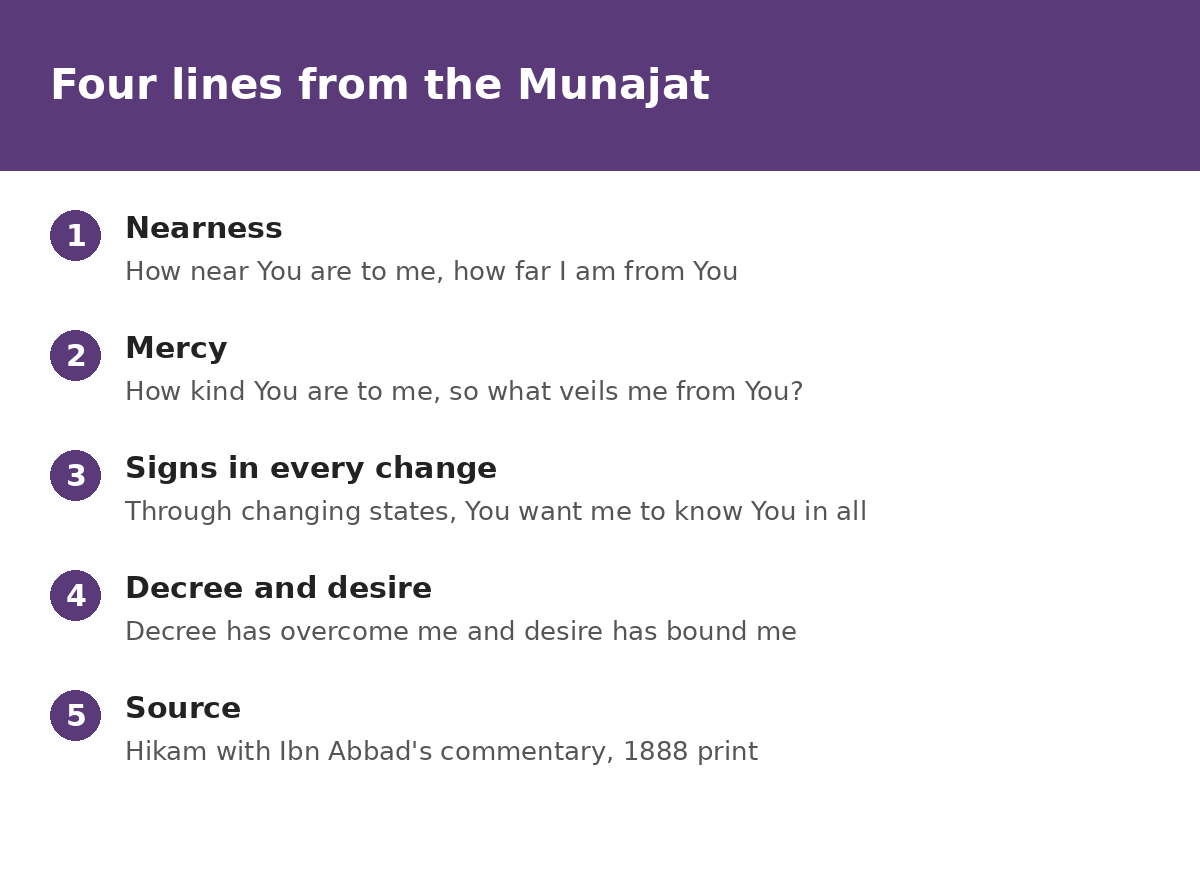
Ibn Ata Allah’s munajat are the intimate supplications that close his famous book of aphorisms, al-Hikam. Ibn Ata Allah al-Iskandari was a Shadhili master who died in 709 AH. After hundreds of short sayings about the heart, he ends by speaking directly to Allah. Each line opens with Ilahi, “my God”.
The source used here
This article is based on an Arabic printing of the Hikam with the classical commentary of Ibn Abbad al-Rundi (d. 792 AH), dated 1888 in its catalogue record. It is scanned in full on archive.org (214 pages). The munajat and their commentary come near the end of the volume, in roughly the last fifteen scanned pages. The Arabic lines below are from that section. The English renderings are my own and give the sense, not a word-for-word translation.
What the munajat are
A munajat is not a request list. It is a confession of need. The Hikam keeps reminding the reader that actions, states and spiritual experiences should not become things to lean on. The munajat put that teaching into prayer: the servant admits weakness, ignorance and dependence, and turns back to Allah alone.
Four lines and what they teach
1. Nearness and distance
إلهي ما أقربك مني وما أبعدني عنك. In sense: “My God, how near You are to me, and how far I am from You.” The commentator explains that the nearness belongs to Allah, while the distance comes from the servant’s own qualities. Your distance is a reason to come back, not a reason to despair.
2. Mercy that should remove the veil
إلهي ما أرأفك بي فما الذي يحجبني عنك. In sense: “My God, how kind You are to me. So what is it that veils me from You?” The question has no complaint in it. It asks the heart to notice that the veil is on its own side.
3. Knowing Allah in every change
إلهي قد علمت باختلاف الآثار وتنقلات الأطوار أن مرادك مني أن تتعرف إلي في كل شيء. In sense: “My God, I have learned from shifting signs and changing states that You want to make Yourself known to me in everything.” Good days and hard days both become lessons in knowing Him.
4. Decree, desire and seeking help
إلهي إن القضاء والقدر غلبني وإن الهوى بوثائق الشهوة أسرني. In sense: “My God, decree has overcome me, and desire has bound me with its ties.” The servant names the struggle honestly. The line continues by asking Allah to be his helper, to help him and help others through him, and to enrich him by His grace so that he no longer needs to ask (فكن أنت النصير لي حتى تنصرني وتنصر بي، وأغنني بفضلك حتى أستغني بك عن طلبي). The commentary reads this as an apology and a confession. Allah is too generous to turn away someone who comes to Him with an excuse and admits his fault.
How to read them today
- Take one line a day. Read it slowly in Arabic and sit with the meaning before saying anything else.
- Use them after your regular remembrance, not instead of it. See our guide to morning and evening adhkar.
- Keep the spirit of the text. These are words of humility, not a formula with a fixed count or a promised result. The source gives no number of repetitions, so none is suggested here.
To place this inside the wider practice of remembrance, read what dhikr means.
FAQ
Where do the munajat appear?
At the end of Ibn Ata Allah’s al-Hikam, after the aphorisms. In the 1888 printing with Ibn Abbad’s commentary on archive.org, they are near the end of the volume.
Is there a set number of times to recite them?
No. The text gives no count or promised reward, so they are best read as heartfelt prayer.
Can I read them in English?
Yes, for understanding. The English here is a loose rendering written for this article, and the Arabic is given beside it.
Leave a Reply